The Orphans of the Circuit

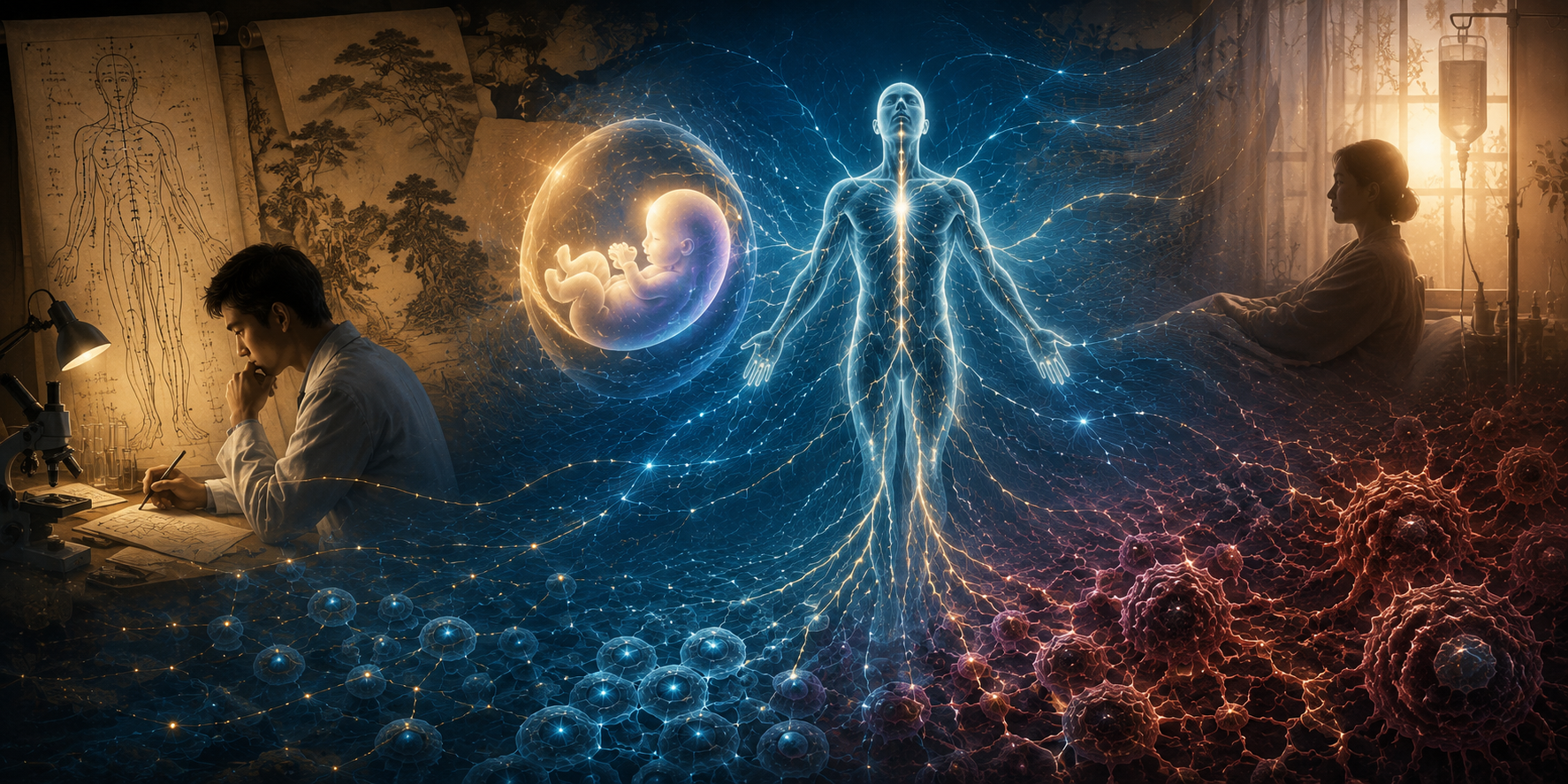
In the autumn of the year my wife Min’s breath grew as faint as falling leaves, I sat in the darkened microfluidics laboratory at the Lawrence Berkeley National Laboratory, staring blankly at a digital rendering of a Xenopus laevis embryo.
When the Human Genome Project was completed at the turn of the millennium, the scientific community rejoiced, believing we had finally deciphered the divine instruction manual for human assembly. Yet, in the subsequent decades, a quiet despair settled over the field of developmental biology. We knew the amino acid sequence of every protein; we knew the catalytic constants of every enzyme. What we could not explain was why trillions of genetically identical cells, all possessing the exact same DNA, knew precisely when to stop dividing and how to fold themselves into a hand, an eye, or a perfectly chambered, beating heart.
If DNA were the sole blueprint, it would be a terribly flawed one. It behaved less like an architectural drawing and more like a builder’s invoice: meticulously listing the specifications of bricks, mortar, and steel, while entirely omitting the sketch of the house.
“Lu, look at this,” my mentor, Professor Patel, said, pushing open the heavy lab door. He placed a faded, digitised rubbing onto my desk: a reproduction of an ancient Chinese Neijing Tu, an ‘Inner Landscape Map’, its surface webbed with delicate ink lines tracing the Conception and Governing vessels.
“This is alternative medicine, Professor,” I said, rubbing my temples. I was exhausted. Min’s latest oncology report had just landed in my inbox; the phase-three targeted therapy had failed, and the malignant cells in her right lung were multiplying with terrifying autonomy.
“No, Lu,” Patel insisted, his eyes bright with a secular sort of reverence. “It is a macroscopic map of the primary circuit, recorded by people who lacked microscopes but possessed an acute sense of systemic flow. The meridians described in traditional medicine were never blood v…

 点赞
点赞 收藏
收藏 点踩
点踩 分享
分享