Introducing Impact List: a ranking of people by the expected value of their donations

TL;DR: I'm releasing a website that ranks people according to the expected value that they've produced via donations, and allows users to re-rank the list using their own assumptions. I'd like feedback and help making it better. This has been crossposted to the EA forum.
I recently built Impact List (impactlist.xyz), a site which ranks people by the expected value of their donations.
The goal is to make the list popular enough that people care about their ranking on it, so that it influences their decisions about where and how much to donate. A secondary goal is influencing people (whether or not they appear on the list) by making them more aware of the large differences in expected value depending on where money is donated.
Of particular interest to LessWrong readers:
'AI existential risk' is currently the the most cost effective cause area according to the default assumptions. If the site becomes popular and if this remains the case as the research improves, it likely will cause more money to flow into AI safety.
I see the hardest problem here as figuring out how to build a process for combining uncertain evidence via LLM analysis, volunteer researchers, and user feedback in a way that is broadly credible. It feels a bit like trying to build a rationalist version of Wikipedia to handle highly uncertain claims while remaining credible to both rationalists and the broader public.
I'm considering creating a more streamlined AI-xrisk-only version of this site. See below.
The site uses QALYs as the common currency of value (converted to 'lives saved' to be more intuitive), but this doesn't mean it's limited to considering only effects on health/lifespan. The goal is to consider value of any type and convert it to human-QALY-equivalents.
I wrote more about the motivation and theory of this project four years ago in this post.
What Impact List is
The core of the site is a ranking of (currently 73) wealthy philanthropists by their expected impact via donations.
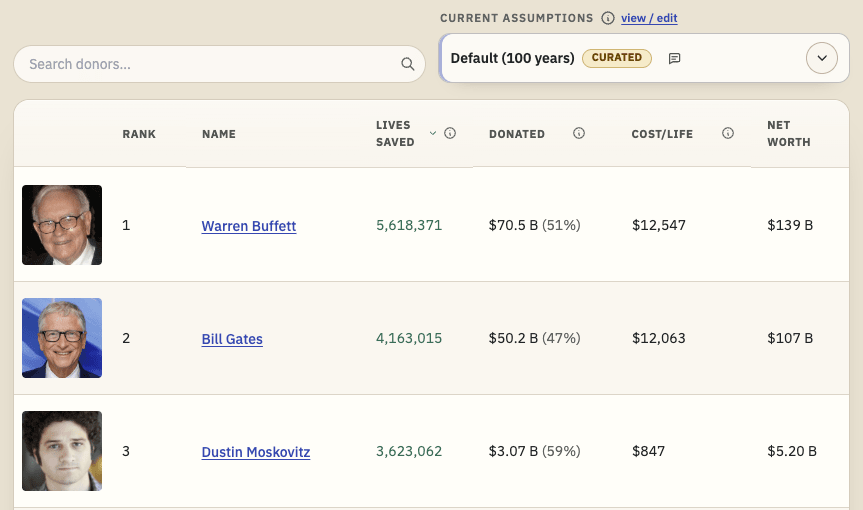
The main list, using the default assumptions
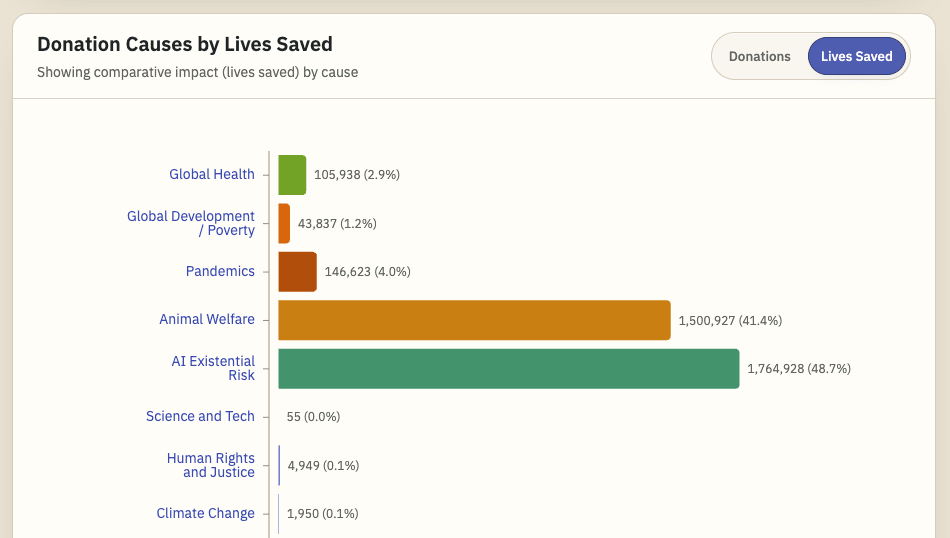
Each donor has their own page showing all their donations (along with the impact of each donation), and aggregate stats by cause area. Users can toggle between 'donations' and 'lives saved' to visualize differences in effectiveness between cause areas. The internal QALY metric is converted into lives saved by defining one life = 80 QALYs.
Expected lives saved by Dustin Moskovitz, by cause area
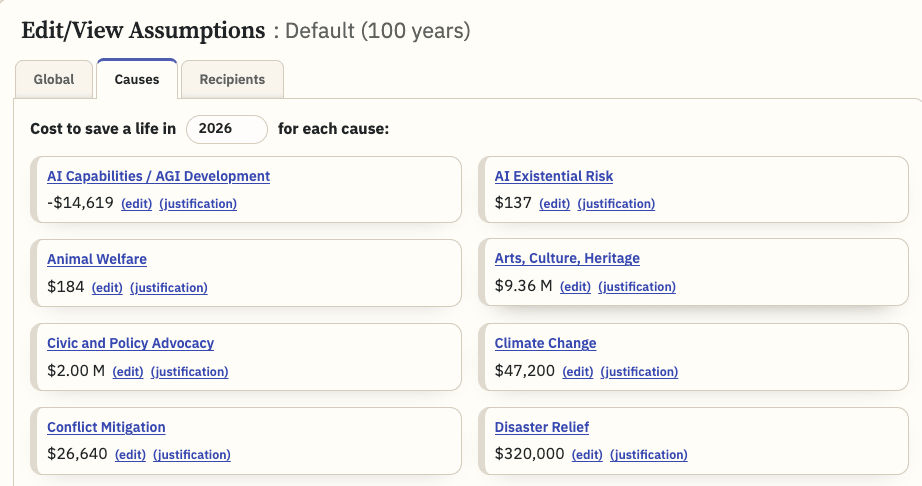
I've split all donations into 28 cause areas, each with their own 'cost to save a life' value.
Eight of the 28 total cause areas, with the option to edit the cost to save a life for each
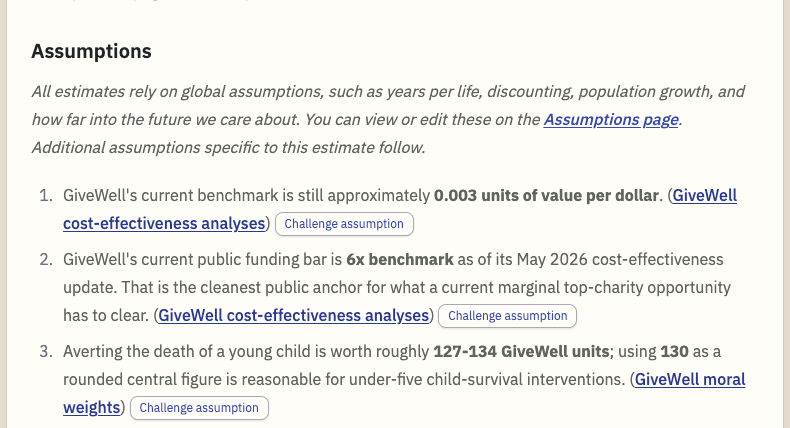
There's also a page for every recipient (charitable organization), which can have its own 'cost per life' value if it's more or less effective than the cause area average. Each cause area and customized recipient has a page with a detailed justification for how the math was done to arrive at the cost per life, and where assumptions are explicitly listed.
Three of the nine assumptions for the Global Health cause area
The estimates are of course very approximate, and will be controversial. I make heavy use of LLMs to do this research, encouraging them to synthesize existing analysis. Users who disagree with any of the default parameter values can edit them.
Editing the three parameters for the Global Health cause area
Users can also edit global parameters specifying their time horizon, assumptions about population growth, and the discount rate.
After entering their own assumptions, users can create shareable links. This allows others to see what Impact List would look like given person X's worldview.
I'd eventually like to add worldviews from notable researchers or organizations, but I'm starting with just a handful of worldviews based on simple tweaks to the defaults:
Users can select between suggested worldviews, or create their own
There's also a calculator feature where people can enter their past donations and/or donations they're considering and see where they'd rank on the list, given those donations.
What I'd like help with
If you see something below that you want to help with, comment on this post, DM me, or join the Discord.
Improving the process of effectiveness estimation
Few people are going to dive into the details of the effectiveness estimates and verify for themselves that the research is high quality. So it's not enough that the estimates be excellent. People need to be able to easily understand and trust the process that leads to the estimates.
The current process is LLM-driven, opaque (users can't see the prompts that lead to the estimates and they can't see how feedback is processed), and dependent on the judgments of someone (me) without any reputation as a researcher. I've tried to partly compensate for this by making the justifications explicit about which assumptions are being made, and tried to make the reasoning as clear as possible, but I expect it'll be very hard to generate enough trust using the existing process.
A few things that could help:
Incorporating something like X's Community Notes on each individual assumption [1], or otherwise making user feedback more of a first-class thing.
Getting people/orgs who have already built up trust to publish their worldviews, and doing some blending between them.
Making the estimation process more auditable, including giving details on currently-behind-the-scenes LLM interactions.
Coming up with some council-of-LLMs framework that minimizes special privilege given to any person or group's judgment. Even if LLMs aren't good enough for people to trust something like this now, maybe they will be in N months.
If you have ideas in this area, please share in the comments. I see this as the most important obstacle to the site becoming popular.
Improving the individual effectiveness estimates
The effectiveness estimates for all cause areas are mostly based on research from LLMs (frontier models from Anthropic and OpenAI). I've also done some manual review and back and forth with the LLMs to refine the estimates. The LLMs rely a lot on existing EA research, but the quality of the analysis is pretty uneven and could probably be improved a lot by putting expert human researchers in the loop.
I'd like these estimates to become the best place to look for a synthesis of all effectiveness research that EAs have done (or found).
If you have expertise in cause area effectiveness research, and especially if you're an expert in some particular cause area, it would be great if you'd be willing to help improve the estimates.
Making the site more usable and beautiful
I think the site looks OK now, but not great (especially on mobile). If you have UI skills/taste and want to make the site look better, let me know.
Getting notable people and organizations to publish their own worldviews
As mentioned above, the site allows anyone to make their own customized set of assumptions and create a shareable link to the rankings using these assumptions.
For notable people/orgs, I'd like to add these links as curated options for all users, so people could see Impact List according to Carl Shulman, Rethink Priorities, etc.
If you're a notable researcher or work in a well-respected EA org, and you also want this to happen, please get in touch.
Go-to-market advice
How should we actually make the site popular? In my post introducing this project I talked about some ideas for how to do this, but I'm pretty uncertain about the right path here.
My sense is that the quality of the site should be significantly higher before I try to popularize this beyond EA/rationalist audiences, but it'd be nice to have a distribution plan soon to guide the other site-improvement decisions.
Feedback on the idea of an AI-xrisk-only version of this site
I’m considering making a version of Impact List focused entirely on AI existential risk. This would avoid many of the hardest comparisons between different cause areas and…

 点赞
点赞 收藏
收藏 点踩
点踩 分享
分享