KdK part 3: Kucharski and the Knickstelle

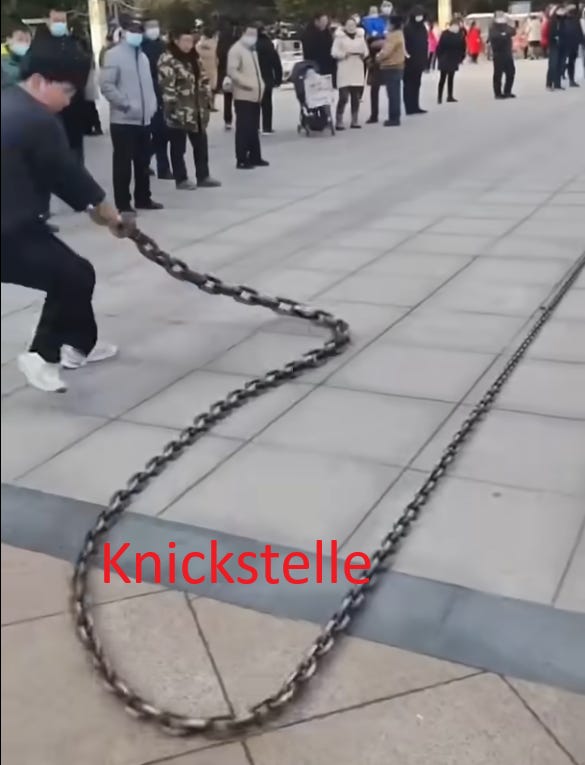
W. Kucharski studied the physics of whips by doing exactly what the guy in this video is doing, so it’s worth clicking that link and watching it in order to visualize his experiments. Here’s a still from it, which I have improved with a label:
According to a note at the end of his extremely detailed and comprehensive 23-page paper 1, Kucharski did most of this work in Berlin in 1935 and 1936 and submitted the paper at the end of 1940. I have always wondered about this man’s life and fate, since Kucharski is a Polish name, and the work detailed in his paper spanned the moment in history when Nazi Germany invaded and crushed Poland. But apparently he was employed at the Society for Applied Mathematics and Mechanics in Berlin during this time.
As mentioned in the previous post in this series, Kucharski seems to have coined the terminology, and devised the basic mathematical model later used (with due credit) by Grammel and Zoller in their paper about the physics of whip-cracking ten years later. The title of this series, Kinetik der Kontinua, his coinage.
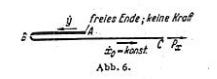
The key to his analysis is to break the system down into three parts: two parallel straight segments of varying length, joined by a 180 degree bend that he calls a Knickstelle (“bend location”). The material of the chain (or whip or whatever) moves through the Knickstelle as the Knickstelle propagates along the medium. He analyzes a number of different scenarios using this basic framework, including this one:
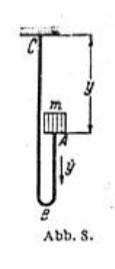
which, as he points out, is an idealized whip.
The mathematical formalism used is a Lagrangian, which is a powerful tool of meta-problem-solving that undergrad physics students often learn after they’ve spent a couple of years solving problems the hard way. It’s exactly the right tool for this job and it enables Kucharski to run easily through a number of different scenarios. In the one shown above, the straight segment on the bottom (C) is held stationary. The Knickstelle (B) propagates leftward drawing th…

 点赞
点赞 收藏
收藏 点踩
点踩 分享
分享