Two Coefficient Givings beat one twice as big


Why the AI windfall should build new grantmakers, not just bigger ones
Originally published at my Funding Anthropalypse Substack.
Imagine you could live in one of two worlds in 2027.
In the first, Coefficient Giving is twice as big.
In the second, there are two Coefficient Givings of the same size.
Which seems better to you?
Having considered it for a while, I would choose the second world. Put plainly, two Coefficient Givings beat one twice as big. I think the potential $37bn+ AI windfall is a once-in-a-lifetime opportunity to achieve this, with significant long-term benefits.
Is effective giving too concentrated?
In my view, yes.
Coefficient Giving (and to a great extent GiveWell) have enormous influence and power within the ecosystem, by virtue of their size and track records. Coefficient Giving is also the predominant or only funder in some of its domains, such as funding the effective giving ecosystem and farm animal welfare.
The situation seems analogous to a monopsony in economics:
monopsony, in economic theory, is a market situation in which there is only one buyer... Although cases of pure monopsony are rare, monopsonistic elements are found wherever there are many sellers and few purchasers. ( Encyclopedia Britannica )
You could argue that there is in fact a diversity of funding in some cost-effective cause areas. For example, in AI safety, there is Longview Philanthropy, the Survival and Flourishing Fund, Astralis, the AI Safety Tactical Opportunities Fund etc.
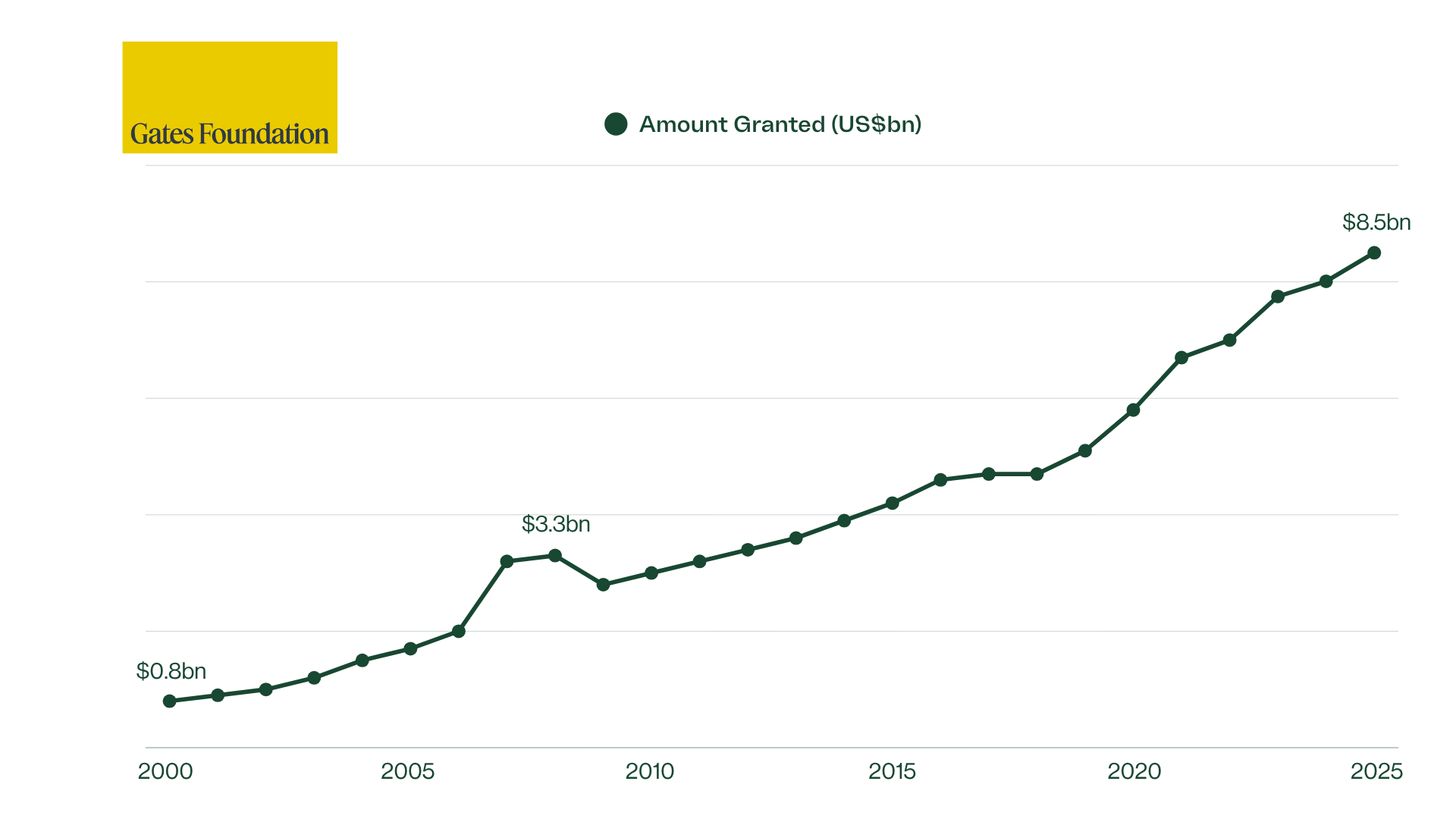
In global health, there is the Gates Foundation (granting roughly 20x more than GiveWell and 8.5x more than Coefficient Giving each year); the remaining bilateral and multilateral funders; and a large number of smaller foundations (Mulago, CRI, WAM Foundation, DRK etc.). You could therefore also claim that the global health landscape is sufficiently diverse.
However, Coefficient Giving outsources a substantial amount of its global health grantmaking to GiveWell - around $1bn to date, and $175m for 2026 so far. It’s therefore not really accurate to describe GiveWell as a counterweight to cG - it could even be considered an extension of it.
More to the point, I think the true test of over-concentration is not just the number of grantmakers in a field - it’s also their size and, more importantly, the amount grantees rely on them. In AI safety, for example, Coefficient Giving gives substantially more, and in almost all cases at least an order of magnitude more, than any other actor. In combating factory farming, it is widely estimated to be the largest funder globally, and in supporting the effective giving ecosystem it is essentially the only funder of note.
Across all cause areas, it is often true that there is no other funder who could step in and become a grantee’s majority funder if the main one walked away.
This, to me, is the true test of over-concentration, and it seems true of both Coefficient Giving and GiveWell, for a large number of their grantees. It is also not just theoretical - it is something that Coefficient Giving’s grantees themselves are concerned about.
In short, Coefficient Giving and GiveWell are exceptionally important to the majority of their grantees, in ways that cause significant risks to the grantees, the ecosystem and the problems we are trying to solve.
What’s wrong with one dominant funder?
To some extent, the answer to this is just ‘read about power concentration’. However, I observe at least five major issues with the current situation.
The first is how dependent grantees are on one organisation for their financial health. The decision of a single program officer, formed under uncertainty, can virtually dictate the grantee’s survival. This is unduly risky for the grantee and also has unwanted second order consequences. For example, I have literally been in strategy meetings where organisations have asked “what will Coefficient Giving think of that?”
The second is that the blind spots of the organisation and individual grantmakers can become significant failure points. Even the very best program officers (and Coefficient has many outstanding ones ) are also human, with biases, limited hours in the day and imperfect judgement. Especially in areas of high uncertainty, it is incredibly helpful to have grantmakers who can step in if another can’t or won’t. And, while dominant organisations may try to hedge internally against their own missteps, I think it is much easier to do this when the decision-makers are separated structurally. That is, several smart people thinking independently about an issue in different organisations are more likely to hedge effectively than the same smart people in the same team or office.
(As an aside, an ecosystem with a diverse set of large funders is also more attractive to top talent, versus one where there is a ‘party line’ and power is concentrated in a single funder. This will likely be relevant if we want to attract a lot more people to work on causes we care about and increase our ability to deploy money well in these fields, something I intend to post about in the future.)
Third, a single dominant funder is also a single point of failure. We are currently all-in on Coefficient Giving and GiveWell’s reputations and assets. We already saw how incredibly damaging it was when the FTX Foundation collapsed and it was only a relatively small fraction of the ecosystem at the time. I am in no way suggesting any malpractice at either organisation - but I am uncomfortable with relying so completely on their continued good judgement and lack of scandal.
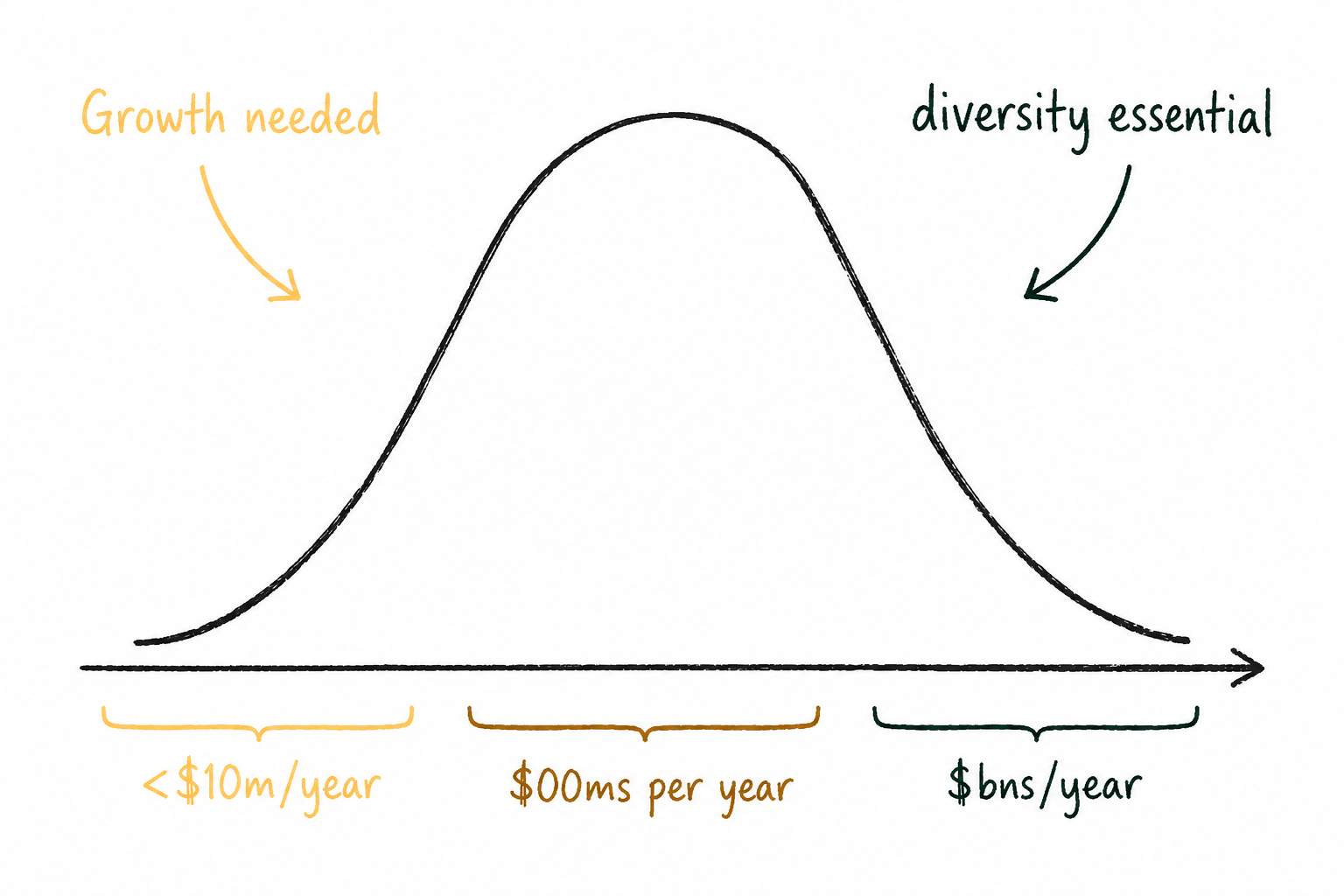
Fourth, it is bad for grantees if a single funder tries to do the majority of grantmaking in a given field, because they are very unlikely to be well-suited to every type of grant. Trying to assess $100m grants alongside $100k seed grants is almost never the right option, because the decision timelines, risk tolerance, due diligence and opportunity costs are completely different at different scales.
At the moment, we expect GiveWell to fund seed grants, mid-stage grants, USAID-collapse-response grants and things at massive scale - but this leads to numerous issues, such as small organisations reporting substantial delays in being evaluated, when they need a rapid review for a grant before their runway expires.
You can instead imagine a pipeline of seed funders and incubators, followed by mid-stage funders who can underwrite growth, before GiveWell funds the best things at serious scale. And this is without even considering that some grantees will have constraints that stop them taking money even from a funder perfectly suited to their stage of life, for example if they want money that is politically-aligned with their other supporters.
Finally, monopsonies also have a dominant function in shaping the market in which they operate. This creates a dominant view of what gets evaluated in the first place (cause areas and organisations), and smaller organisations usually follow their assessments. Unless we assume that their judgement is perfect, and that big organisations can adapt at speed when the situation evolves, this is sub-optimal.
Can GiveWell and Coefficient Giving absorb the windfall?
The two most dominant organisations in the space are making concerted efforts to grow quickly. Both are hiring fast and both are specifically focusing on high-absorption options to deploy more money quickly. They are also outstanding grantmakers and some of the only places with track records of handling hundreds of millions in grants. You can see the attraction for time-poor donors, looking for a safe place to give.
However, the scale of the Funding Anthropalypse is likely to exceed their capacity, even if that capacity increases significantly. Last year, GiveWell regranted $418m, and Coefficient Giving over $1bn. Even with the most aggressive scale-up plan imaginable, it seems unlikely to me that either organisation can even 5x its grantmaking in the next 24 month…

 点赞
点赞 收藏
收藏 点踩
点踩 分享
分享