How public opinion is turning against AI

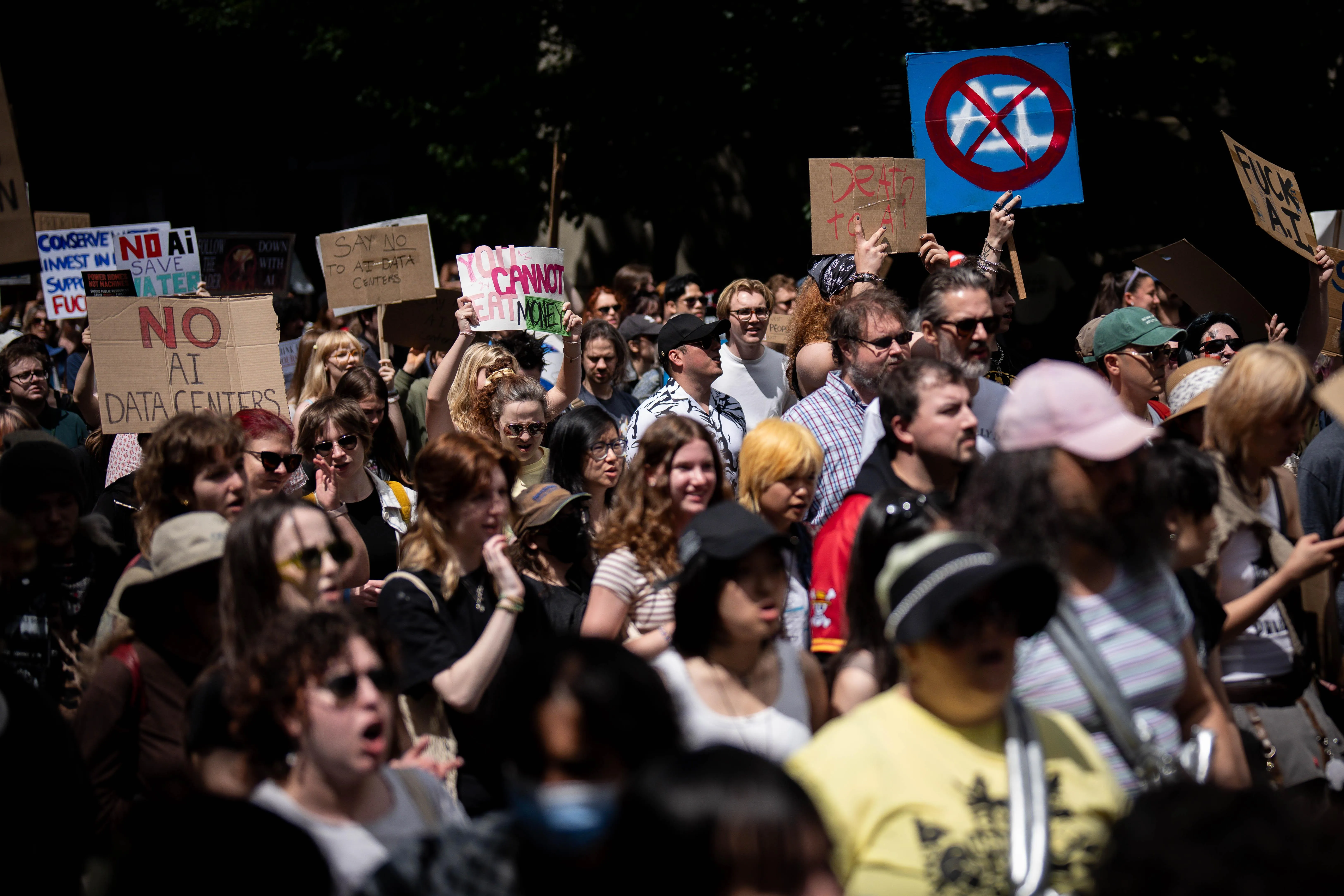
Demonstrators march during a protest against AI data centers in Vancouver, British Columbia. | Ethan Cairns/Bloomberg via Getty Images
AI was supposed to make our lives better. Instead, it’s made many of us scared and angry. Communities are protesting against the building of new data centers — the warehouses of IT equipment powering the AI buildout — across the country, and increasingly they’re winning. And polling shows most Americans think AI is moving too fast.
So how did public opinion on AI curdle so quickly? Jasmine Sun, who reports on the industry from San Francisco, argues that the backlash treats AI less as a technology and more as a political project. “The debate was not about like, is ChatGPT useful to me?” Sun told me during a taping of Vox’s The Gray Area. “The debate was actually something more like, there are these big corporations and unaccountable billionaires…coming into my city, coming into my life and changing it without having any sort of democratic input?”
Filling in for Sean Illing, I talked to Sun about the rise of “AI populism,” the parallels with the Industrial Revolution, and how the backlash could crash into the 2028 presidential election.
As always, there’s much more in the full podcast, which drops every Monday, so listen to and follow us on Apple Podcasts, Spotify, Pandora, or wherever you find podcasts.
You’ve been writing about a phenomenon you call AI populism. How would you define that? What is AI populism?
I define AI populism as a worldview where AI is not seen as an ordinary technology, but specifically as an elite political project to be resisted. I came to the term while thinking about the AI backlash and the reasons people are increasingly anti-AI — whether that’s LLM slop, whether that’s Waymos in their city, whether that’s a new data center project. One thing that occurred to me was that a lot of times the debate wasn’t about whether ChatGPT is useful to me, or whether Waymos are safer than a human driver. The debate was actually something more like: There are these big corporations and unaccountable billionaires who are coming into my city, coming into my life, and changing it without any democratic input.
When I talk to people who are opposing AI in various ways, they seem more concerned with this concentration-of-power, anti-elite dimension — which is where I take the word “populism” — rather than classic AI safety concerns, which are more about the technical characteristics that might introduce risk.
You wrote a piece that touched on some of this but went to a darker place — “ AI populism’s warning shots” — and you wrote about actual shots. Sam Altman, the CEO of OpenAI, was targeted by a Molotov cocktail and a shooting within the span of a couple of days. There was an Indiana councilman who voted for a data center and woke up to gunshots at his home and a note reading “ no data centers.” Why do you think of those incidents of violence as warning shots of something to come?
It was pretty scary. I’m no Sam Altman fanboy, but it’s terrifying that assassination attempts are showing up in response to people’s worries about AI. One factor is that we’ve been seeing a rising wave of political violence and support for political violence in the US, especially among young people, over the past few years — the UnitedHealthcare CEO shooting, the Charlie Kirk shooting. Increasingly, a lot of disaffected, maybe nihilistic young people are turning toward political violence as a way to express political beliefs they don’t feel they have other channels for. Or maybe that person is just unwell. But I do expect to see more of it, because my theory of political discontent is that if people feel they have institutional channels to bargain for their rights — if they feel the democratic process is working, or they’re part of a union and believe their union leader will go bargain about how automation shows up in the workplace — they’ll most likely go through those channels.
When it feels like the official channels aren’t working, opposition becomes much more diffuse and volatile. That’s part of why, in creative communities, you’ll see people witch-hunting each other over AI use. I think we’ll see more political violence against people seen as AI leaders, or as supporting AI leaders.
That’s really scary.
Yeah, I’m quite worried about it. But again, my sense is that it comes from a feeling of — what else is there to be done, when you have this level of concentration of wealth and power, and there’s no democratic input right now into how AI is regulated or built?
It’s like a jump straight from complaining at your community meeting about the data center to an act of violence.
I was talking to some friends about this. During the 20th century in the US, there was a wave of factory mechanization and automation, but unions were really strong — often when a company said, “We’re going to bring in these machines,” they’d sit down with the factory union leader and say, “Okay, you can bring in the machines, but we’re going to couple that with a wage increase,” or a 35-hour workweek, or earlier retirement. There was a channel to make a deal about how automation would show up in your workplace. That meant people were more likely to accept it as something lifting all boats. I don’t think that’s happening now — most of the industries affected by AI aren’t organized in labor unions, and the democratic channels are questionable at best.
It’s like when people have agency to be part of the transition, the process goes a lot smoother. Is there a historical analogy for a technological change that didn’t allow for input from the people involved? I’m thinking of the Luddites.
The Luddites are a good example. When the automated looms were introduced, there was a lot of violence against the looms. The book I’d really recommend here is Carl Benedikt Frey’s The Technology Trap. He’s an Oxford economist who studied a ton of historical examples — in Europe, in China, all over the world — including the Luddites and 20th-century automation. His central question was: In what contexts do workers successfully stop automation, and in what contexts do they allow it to be introduced? How does the political environment, or the balance of power between people and their leaders, change the outcome? He found that when automation was introduced alongside social welfare policies — a higher minimum wage, some form of redistribution — people were much more willing to accept it, which is fairly rational.
I want to talk about Silicon Valley’s understanding of this backlash more generally. You’re painting a pretty dark picture, and you’re right in the belly of the beast in San Francisco — I’m sure you talk to people involved with AI every day. Is there a moment when it clicked for them that this backlash is real and something they have to take seriously? Or has that happened yet?
I’ve definitely noticed a huge difference, over the past six months, in how seriously people in Silicon Valley take the AI backlash.
Like what?
People just talk about it more. I’d bring up AI populism to people last year, and they’d normally say, “It doesn’t matter — technology always introduces some discontent, people get annoyed but they get used to it, like the internet.” That was the standard reaction last year. Not anymore. I think part of the reason OpenAI and Anthropic have felt pressure to introduce economic policy proposals around job automation is that they’re seeing how worried people are. The data center moratoriums and the broader data center backlash have been surprising and meaningful in getting AI leaders to recognize they have both a messaging problem and an actual problem with the product and the technology they’re introducing.
A lot of the increasing opposition to AI in Washington has caused people to see this too. At first, Trump — as you mentioned — was very pro-AI. He and David Sacks were accelerationists; they wanted AI to go faster and to block attempts…

 点赞
点赞 收藏
收藏 点踩
点踩 分享
分享