Reinforcement Learning Quantum Error Correction: Google’s Willow Learns to Calibrate Itself

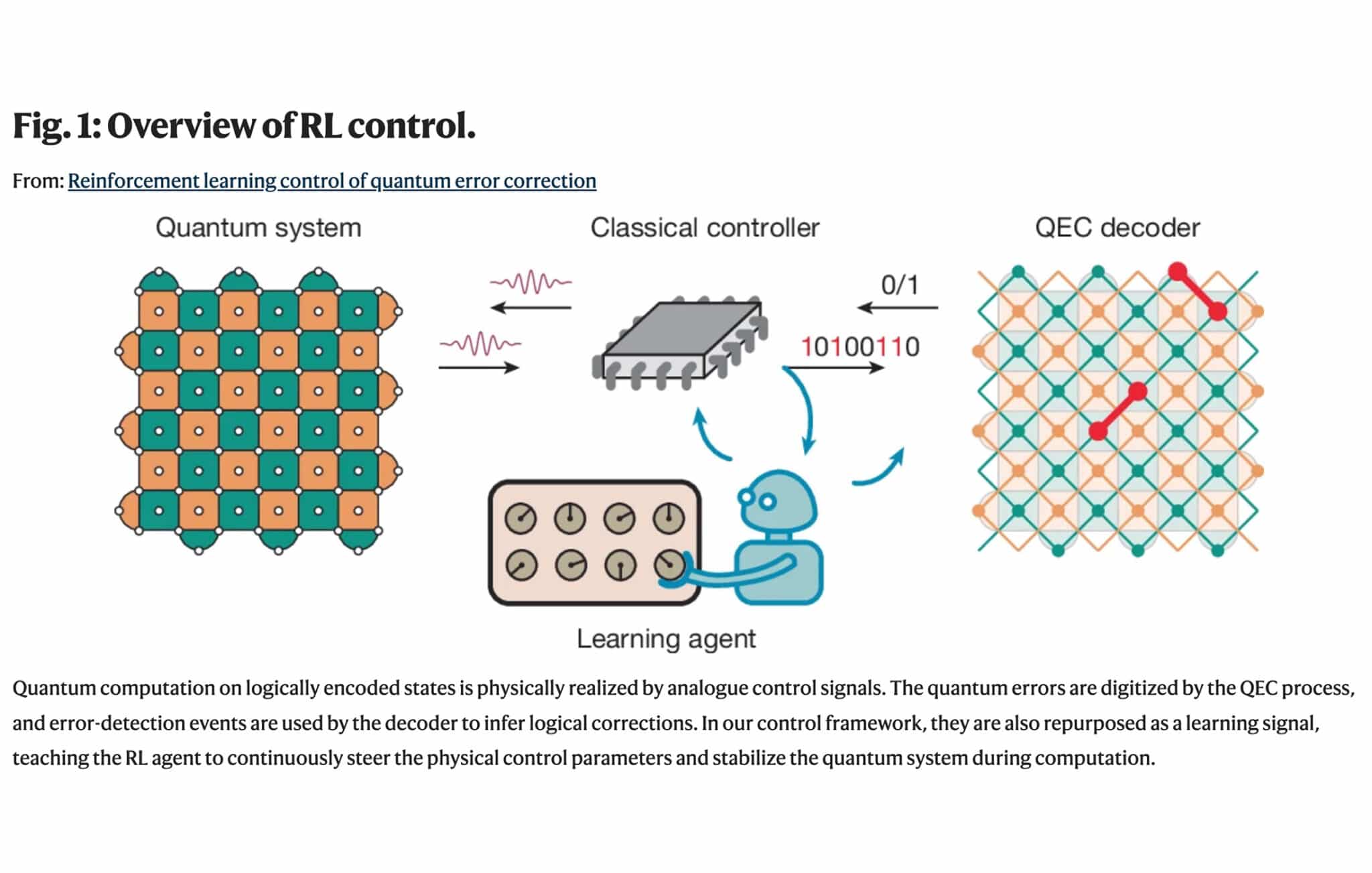
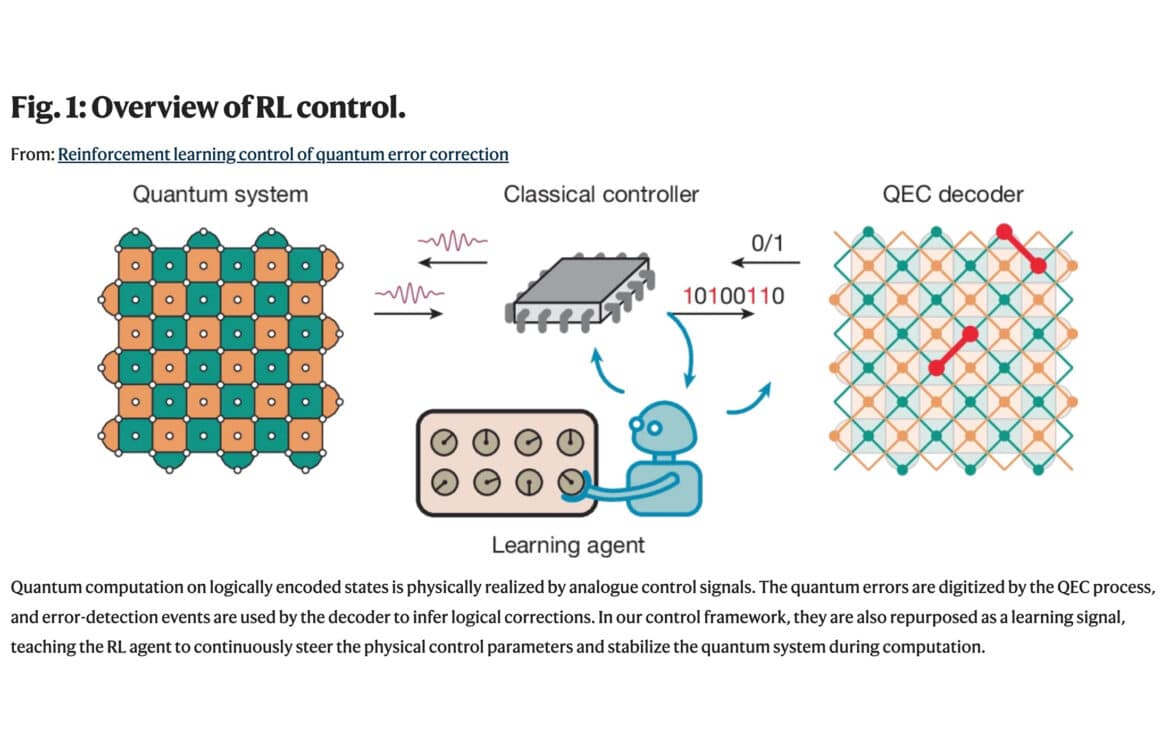
Table of ContentsMy AnalysisDowntime is the bottleneckThe surrogate objective is the clever partWhat ran on hardware and what ran in simulationInjected drift, natural drift, and the missing wall-clockThe agent is a GaussianWhere this lands on the CRQC map
July 8, 2026 — Google Quantum AI and Google DeepMind published a Nature paper demonstrating that a reinforcement learning agent can calibrate a quantum processor using the error-detection events that quantum error correction already produces, steering the controls while error-correction cycles run rather than in dedicated tune-up passes. The study, led by Volodymyr Sivak and Alexis Morvan and credited to 299 authors in total, ran on Google’s Willow superconducting hardware. It is the first demonstration of reinforcement learning quantum error correction control at the scale of a full error-corrected processor; earlier experimental work applied RL to isolated gates and bosonic codes.
The agent manages more than 1,000 control parameters, the analog settings that specify how an abstract QEC circuit is translated into the waveforms that control the chip. Against artificially injected drift, its steering improved the stability of the logical error rate 2.4-fold; adding decoder steering brought that to 3.5-fold. Applied after Google’s full conventional calibration process and expert tuning, RL fine-tuning cut the logical error rate a further 20%, a result the team reproduced across five independent runs on each of two code types. Synthesizing these techniques produced what the authors describe as record error-corrected performance across any physical qubit modality: a distance-7 surface code with a logical error per cycle of 7.72(9)×10⁻⁴, decoded by the AlphaQubit2 neural network, and a distance-5 color code at 8.19(14)×10⁻³ with the Tesseract decoder. For comparison, Google’s December 2024 below-threshold result reported 0.143% per cycle at the same distance-7; the new figure is roughly half that, thoug…

 点赞
点赞 收藏
收藏 点踩
点踩 分享
分享