I became the QA engineer for my own coding agent. Help!

Your coding agent writes in an hour what your team used to write in a sprint. The part that decides whether that code is any good did not speed up at all.
I am a backend developer. For years I did not touch the frontend at all, and I was fine with that. Then the coding agents got good, and I started building the UI for my side projects with AI. This was late 2025. Back then I was on Cursor. These days I live in Claude Code.
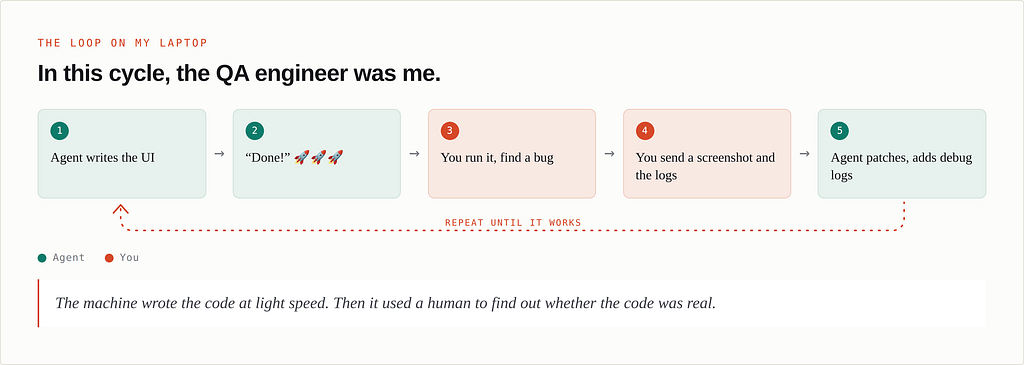
The loop was always the same, and looking back, it taught me everything.
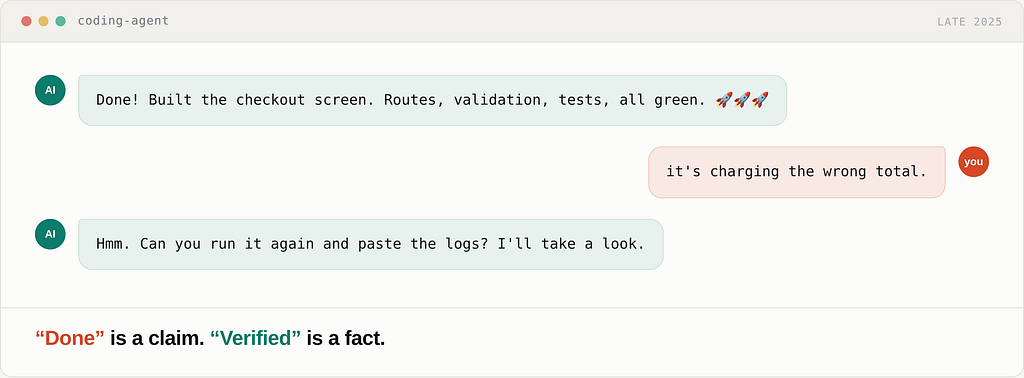
The agent would build a screen. Then it would tell me it was done, usually with a little pile of rocket emojis, like it had just landed something on the moon. 🚀🚀🚀
So I would open the app and try it. Something was always off. Sometimes the layout was broken. Sometimes a button did nothing. Sometimes the whole thing looked perfect and quietly did the wrong thing under the surface.
So I would take a screenshot, or copy the errors out of the console. I would write up what went wrong and hand it all back.
The agent would change some code. Often it would add a few debug logs and ask me to run the app again and send it the output, so it could work out what was actually happening.
Read that again. The thing that wrote the code could not tell whether its own code worked. And when it could tell something was wrong, it usually could not find the reason on its own. It needed me for that.
I was the tester. I was the QA engineer. I was its eyes. The agent wrote at machine speed, then used me, one slow human, to find out if any of it was real.
For a weekend side project, fine. But I remember sitting there and thinking, this does not scale. You cannot build serious software this way. Not because the agent writes bad code. Because nobody taught it how to check its own work.
That little loop on my laptop is the whole story of engineering right now, only scaled up to teams of hundreds. And almost nobody is naming it.
In this loop, the machine wrote the code and the human became its test suite.
The thing we never questioned
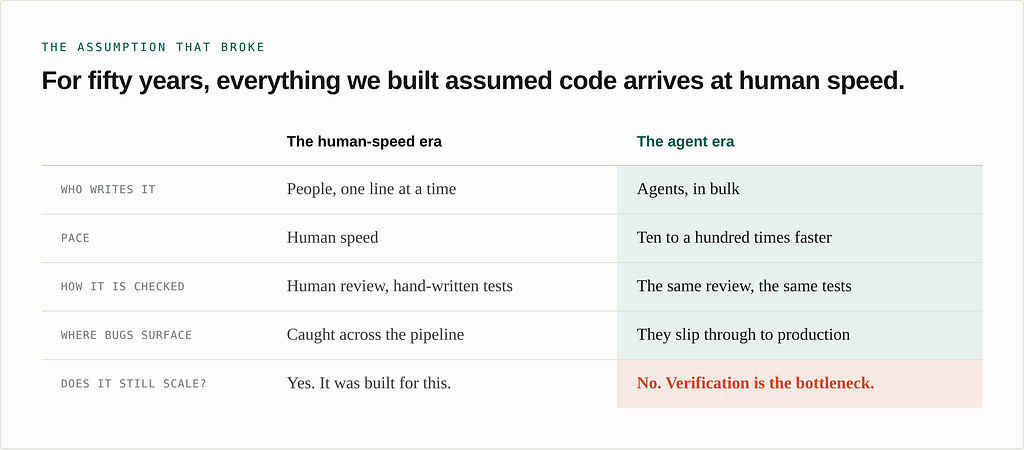
For as long as software has existed, writing the code was the slow and expensive part. Every line passed through a human brain before it existed. That one fact quietly shaped everything else we built.
We review code because a person wrote it, and people make mistakes. We write tests because we can only cover so much by hand. We built CI gates, staging environments, and slow careful rollouts. All of it sits on top of one belief nobody ever says out loud: code shows up at the speed a human can type.
For fifty years that was simply true. So we never questioned it.
Now it is false.
The human-speed era versus the agent era. Everything downstream was built on an assumption that no longer holds.
The wall we built for a slower world
Coding agents like Claude Code, Cursor, and Copilot produce in an hour what a team used to produce in a sprint. This is not a prediction. It is already how a growing share of the world’s code gets written, and that share only moves one way.
But look at what did not change. Verification. The part where you decide whether the code is actually good.
Every line an agent writes still runs into the same wall we built for the old world. A human reads the diff. A test suite someone wrote months ago runs again. A CI check looks for the few things it was told to look for. And whatever slips past all of that gets found in the worst place there is: production, by your users, usually at a bad hour.
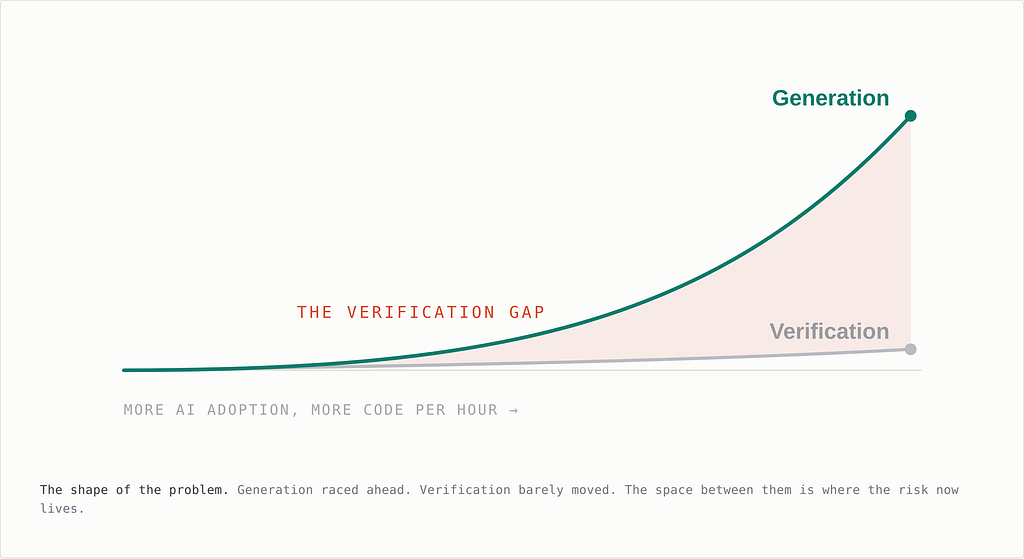
So here we are. One side of the work got a hundred times faster. The other side did not move an inch.
Generation raced ahead. Verification barely moved. The space between them is where the risk now lives.
Writing code went to almost free. Trusting it is still done by hand, one tired human at a time.
The bottleneck did not leave. It moved.
For decades the slow step was “can we write this fast enough.” We threw money and tools and our smartest people at that step for years. And we won. That step is basically solved.
So the pressure did what pressure always does. It rolled downhill to the next slowest step. And the next slowest step is trust.
Watch what teams do when they feel this. They pick one of two bad options, usually without deciding to.
Two bad options, and most teams pick one without deciding to.
Neither group is being careless. They are both just stuck with a way of building trust that was designed for a world that no longer exists.
You cannot review your way out
Here is the part most teams get wrong. You cannot fix this by trying harder at the old thing.
Manual verification does not scale with generation, and it never will. If your agents write ten times more code, you do not suddenly have ten times more senior engineers to check it. You cannot hire your way out. You cannot review your way out. Reading is slow because understanding is slow, and no amount of effort changes that. Every extra line of generated code makes the gap wider, not smaller.
This is why “the AI writes so much code now” is only half the story. Writing was never the whole job. Shipping software that people can rely on is the job. And that job still has one step stuck in the past.
You did not speed up your whole process by bringing in agents. You sped up one stage and dumped all the pressure onto the next one. A pipeline moves only as fast as its slowest step. For almost everyone right now, that slowest step is trust.
Choose how you close it
So what does the way out look like? Not more reviewers. Not more meetings. Not a bigger pile of tests for humans to babysit.
The only thing that can keep up with generation is verification that runs as fast and as automatically as the generation does. Something that checks the work the moment it is made, before a human ever looks at it, and hands back a clear answer with real proof behind it.
We are not all the way there yet. That is exactly what makes it the most interesting problem in software this decade.
Because the gap is open right now, in every team running coding agents, and it grows a little wider with every commit. You do not get to ignore it. You only get to choose how you close it. On purpose, early, right where the code is born. Or by accident, later, in production, at the highest price the system can charge.
Making the machine do the work used to be the hard part. That race is over. The next race, the one that decides who actually ships good software fast, is verification. And it has barely started.
WHERE I’M COMING FROM
This is the exact problem we are building IronBee to solve, verification that keeps up with the code your agents write. It is public now.
See how it works → ironbee.ai
Start using it → console.ironbee.ai

 点赞
点赞 收藏
收藏 点踩
点踩 分享
分享