Moonshot’s Kimi Upends Conventional Wisdom on US Lead Over China

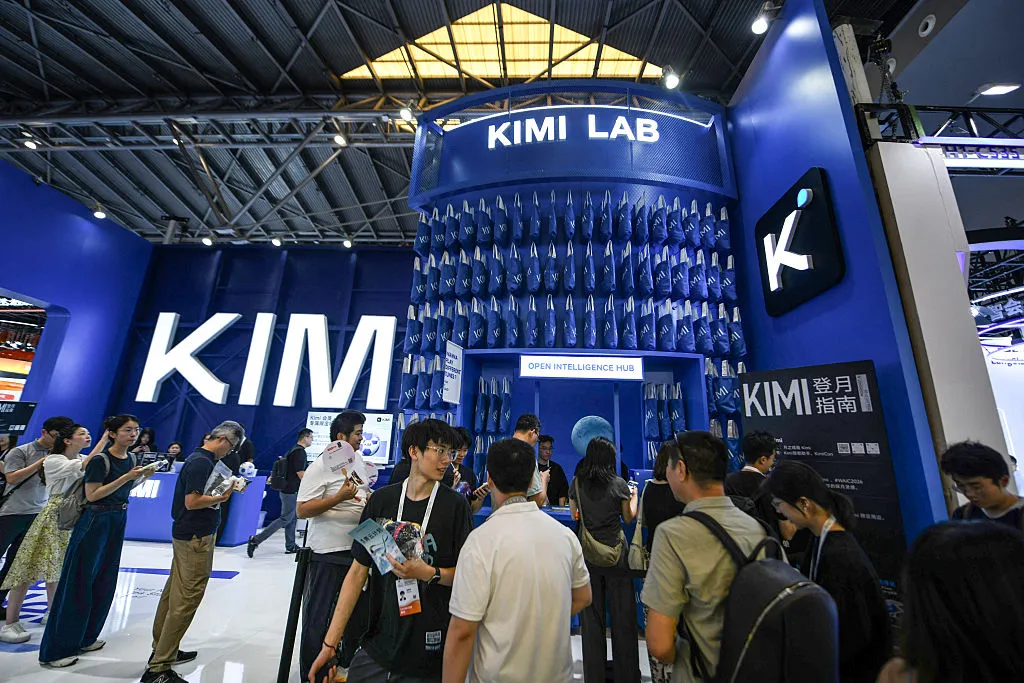
The Moonshot AI stand, featuring Kimi K3, during the World Artificial Intelligence Conference in Shanghai on July 17.
At an event in Beijing earlier this year, some of China’s top artificial intelligence leaders warned that the country remained meaningfully behind the US in developing cutting-edge AI models, with one executive arguing that “the gap may actually be widening.”
Leading US firms also appeared confident they were significantly ahead. As recently as this week, one executive at Anthropic PBC, who spoke on condition of anonymity, mused that the Claude maker’s technology was roughly six to 12 months ahead of Chinese rivals.
On Friday, Moonshot AI Inc. upended those assumptions. The Chinese AI lab released Kimi K3, a more advanced open-weight model that it said outperforms all rivals except for Anthropic’s Claude Fable 5 and OpenAI’s GPT-5.6 on overall capability. The implication is that Moonshot, and by extension China, could be closing the gap faster than expected.
“We used to say that the open-source models, in particular the Chinese models, are behind the frontier models... by, I don’t know, six to nine months,” said Ion Stoica, a computer science professor at the University of California, Berkeley who co-founded Databricks Inc. and AI model ranking platform Arena. “Right now, they may be two to three months.”
The surprising gains in performance have stunned some AI watchers and investors, fueling a tech rout with echoes of the DeepSeek moment last year. As with DeepSeek, the Kimi release has touched off concerns about whether the immense spending commitments from Silicon Valley will pay off and shaken confidence in the US lead.
“This is certainly a surprise, I think, for a lot of folks,” said Aaron Levie, co-founder and chief executive officer of Box Inc. “It’s the only thing people are talking about in the valley.”
Levie said K3’s reported performance represents a “pretty huge breakthrough” for an open model as they tend to be more affordable and customizable than closed, or proprietary, offerings, but also notably less powerful.
Moonshot’s gains may complicate efforts by US regulators to safeguard new models. OpenAI and Anthropic each delayed their latest releases under pressure from the Trump administration to review them first. Any future slowdown in launches now risks giving China extra time to catch up, compromising the White House’s ambition to maintain AI supremacy.
Moonshot’s release could also undercut OpenAI, Anthropic and others on price at a moment when they’re confronting customers who are becoming more conscious of their surging AI spending. Some developers have turned to so-called model routing services that can seamlessly direct users to cheaper options, including from China, for specific tasks to maximize cost efficiency.
One executive at a US AI lab, who spoke on condition of anonymity, said they expect American firms will continue to differentiate their products with new innovations, but the greater competition will put new pressure on them to demonstrate a better value proposition. That would include the price tag as well as data integrations and the user experience, the executive said.
Representatives for OpenAI and Anthropic did not respond to a request for comment.
In its blog post announcing K3, Moonshot also acknowledged certain limitations. “Despite being a highly competitive model overall, K3 nonetheless exhibits a noticeable gap in user experience compared with Claude Fable 5 and GPT 5.6 Sol,” it said.
Read more: DeepSeek Champions China’s Bid to Flood the World With Cheap AI
With DeepSeek, much of the attention was driven by the startup’s claims to have developed a competitive, freely available model for a small fraction of the cost of its US peers. Moonshot’s K3, by comparison, is significantly pricier than its prior version and on par with Anthropic’s mid-tier models, according to estimates. It’s unclear, however, if the cost might change when the model is hosted by US computing providers, and if K3 will cost more on a per-task basis.
It’s “the most expensive model released by a Chinese AI lab to date,” developer Simon Willison wrote in a blog post.
Moonshot appears to be betting that it can charge higher pricing for a premium product that performs well on coding and other lucrative agentic tasks. Moonshot said K3 has 2.8 trillion parameters, a measure of a model’s complexity.
As of Friday afternoon, K3 ranked first on an Arena leaderboard rating how AI models perform on certain web-development tasks. Stoica said early results, particularly when it comes to coding, indicate K3 is in the “same ballpark” as Anthropic’s Fable and OpenAI’s high-end GPT-5.6 Sol model.
Anthropic has previously accused Moonshot and other Chinese firms of working to “illicitly extract” results from its AI models to bolster the capabilities of rival products faster and more cheaply. Moonshot has not responded to those allegations.
Even before K3, AI leaders in the US had taken notice of gains from China. “The Chinese open-source models are getting very good,” OpenAI’s Sam Altman said in an interview with CNBC earlier this month. “But I also think we will continue to have the best models in the world and people really want the best models in the world.”
In an analysis published Friday, the UK’s AI Security Institute estimated that open-weight models from China had narrowed the gap with the US on cybersecurity capabilities specifically to 4-7 months, from 6-10 months in the year prior.
“It’s uncertain how the gap will evolve,” the group said. It intends to test K3 in the future.