Why there’s no cheaper alternative to Plaid for US bank data (I checked all of them)

I build a personal finance app. That means I pay for the privilege of reading your bank account, with your permission, so the app can show you where your money went. The company that sells me that privilege is Plaid, and Plaid is not cheap. In fact, it’s because of plaid that I can’t offer a true free tier of my app.
So I did what any founder watching their margins does. I went looking for something cheaper. I checked all of them. Here’s what I found, and why I’m still on Plaid.
The thing everyone gets wrong about “cheaper”
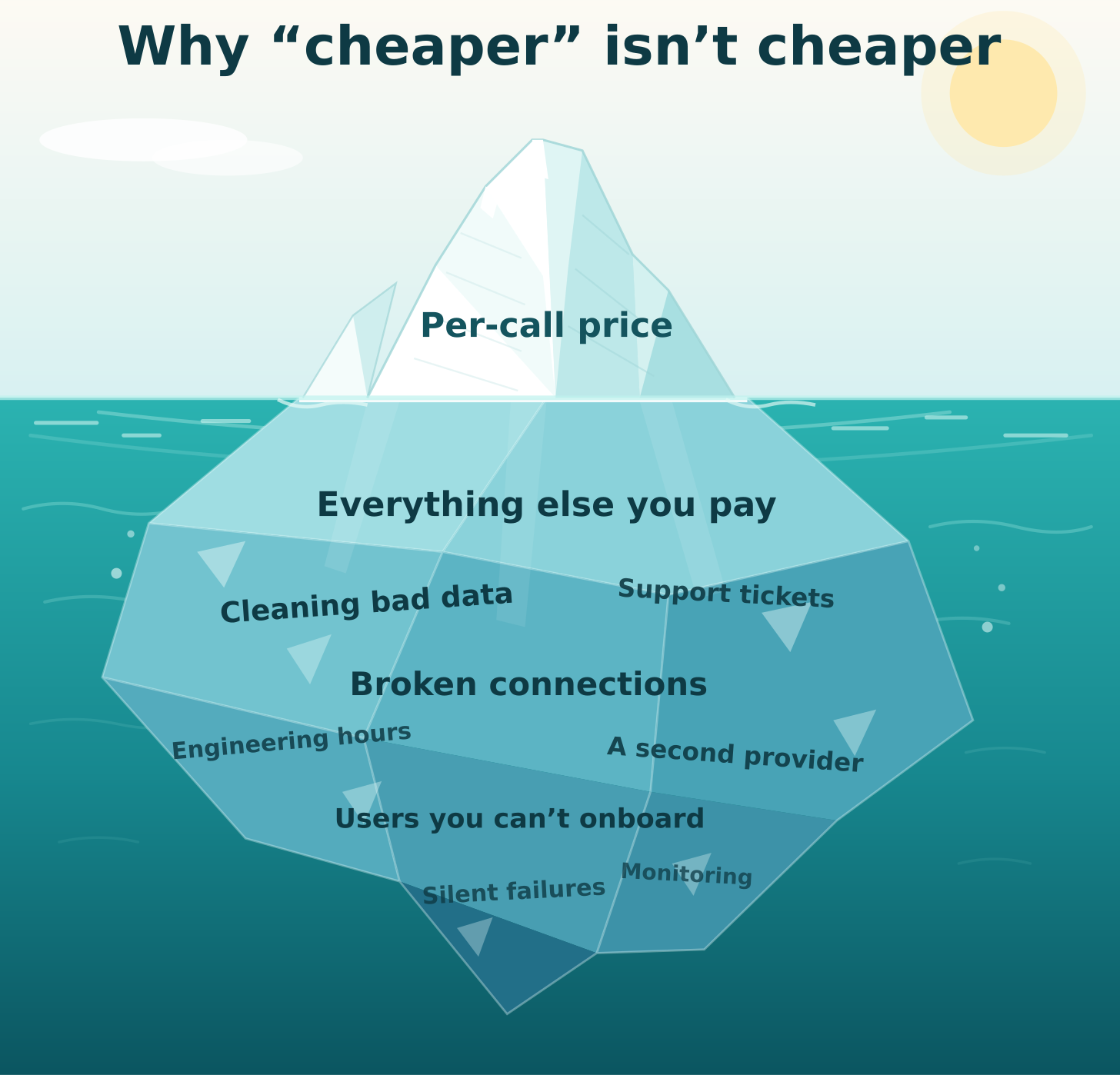
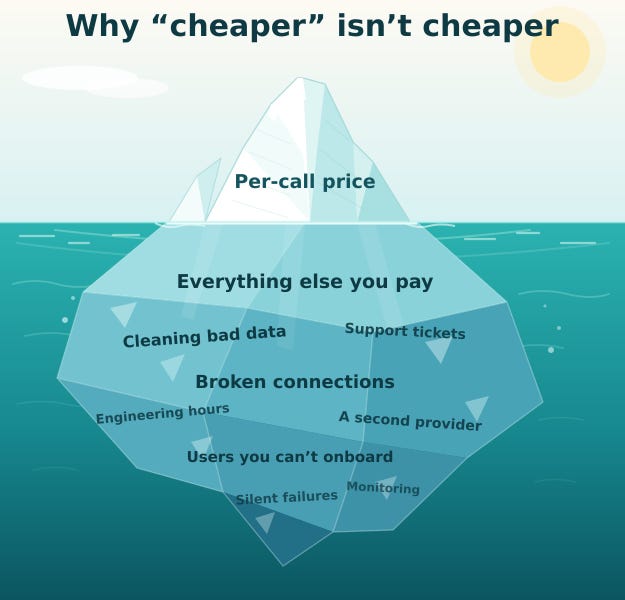
Per-call pricing is the number people quote when they tell you a competitor is cheaper. It’s also the least important number.
The cost of a bank data aggregator is not the sticker price of an API call. It’s the sticker price, plus every hour of engineering time you spend cleaning up bad data, plus every support ticket from a user whose connection silently broke, plus every signup you lose because the app couldn’t reach their bank at all.
A cheaper API that covers fewer banks isn’t cheaper. For a consumer app in the US, where a user might show up with a credit union you’ve never heard of, coverage is everything. If I can’t connect the account, the price per call is zero and also irrelevant, because I never had that user to begin with.
The contenders
MX. Genuinely good, especially at transaction enrichment, which is the unglamorous work of turning “SQ *COFFEE 4457” into “Blue Bottle, Coffee.” If your product lives or dies on clean categories, MX is a real argument. But it’s priced and structured for enterprises. Not cheaper. Just built for huge companies.
Yodlee. The old default. Enormous coverage, including brokerage accounts, twenty-plus years in the space. Also a developer experience that engineers AI described as painful..
Akoya. API-only, no screen scraping, backed by the big banks themselves. Philosophically the future: direct, permissioned, clean. In practice its coverage is narrower than Plaid’s, so for a broad consumer app you’d end up running Akoya and something else, like Plaid. That’s where the usefulness drops off. It’s also priced for enterprise with minimums higher than what I’m willing to pay starting out.
Teller. This is the honest exception, so I’m not going to pretend otherwise. Teller is legitimately cheaper for the right team, with a clean modern API and reliable direct connections that a lot of engineers prefer to Plaid. If you serve a concentrated user base whose banks all sit inside Teller’s coverage, it can genuinely win on total cost, not just sticker price. The catch is same as many others: coverage. It’s not quite up to the level of plaid, so you’re losing some customers if you rely just on them.
The European crowd (TrueLayer, Tink, Yapily, GoCardless). From what I read these companies are generally great. They’re regulated, often cheaper, but just limited to European banks. Open banking regulation in Europe forces banks to expose clean APIs, which is why those providers can be lean. The US has no equivalent mandate that’s fully in force, so US aggregators are doing harder, messier work, and charging for it.
The real reason it’s expensive
In Europe, regulations force banks to hand over clean data through standard APIs. The aggregator’s job is comparatively easy, so competition drives the price down. In the US, there’s no fully enforced equivalent yet. Aggregators have spent years building and maintaining thousands of individual bank connections, negotiating direct API deals with some, and holding the whole fragile thing together as banks continue to struggle to build clean interfaces.
Plaid is expensive because connecting to twelve thousand American financial institutions is a genuinely hard, ongoing, unglamorous problem, and someone has to pay for it. Every use of Bonsave does this through a portion of their subscription
Why can’t the U.S. be more like Europe?
The CFPB’s open banking rule (the 1033 stuff) is the thing that could actually change things, by forcing US banks toward the same clean, mandated API access that made European aggregation cheap. The bad thing is I’m watching it closely, and there’s money pouring into opposition of this bill by banks. It’s tied up in legal battles as I write this.
To be clear, I think this sort of bill has to pass eventually in the U.S., it’s just a matter of time (and who’s president). This data is our data. It’s our financial data and you should be able to access it in any way you choose. In fact, you already do access that data via API’s. Just ones created ad-hoc for each bank’s website. What the U.S. is attempting to mandate is that the API is optionally structured in a standard, secure way.
So until that happens in a few years, Plaid is the expensive option that’s still cheaper than the alternatives once you count everything.
Maybe once the need for Plaid wanes I’ll be able to offer a free tier, but then there’s the AI cost…
To receive new posts and support my work, consider becoming a free or paid subscriber.

 点赞
点赞 收藏
收藏 点踩
点踩 分享
分享