How Polarization and Democratic Backsliding Affect Public Sector Recruitment

What happens to people’s inclination to work in government when they face an administration they see as ideologically extreme, corrupt, undermining democracy, or acting against the public interest?
Albert Hirschman provided a typology that has been widely applied to this situation: exit, voice, and loyalty, which some have expanded to include other categories such as neglect, resistance and sabotage. One problem is that these typologies only consider existing employees, not potential employees – those outside government who are motivated to serve society and to influence public policy.
So, how do potential entrants respond?
Can We Still Govern? brings you expert insights into how governance. To support this work, consider becoming a free or paid subscriber.
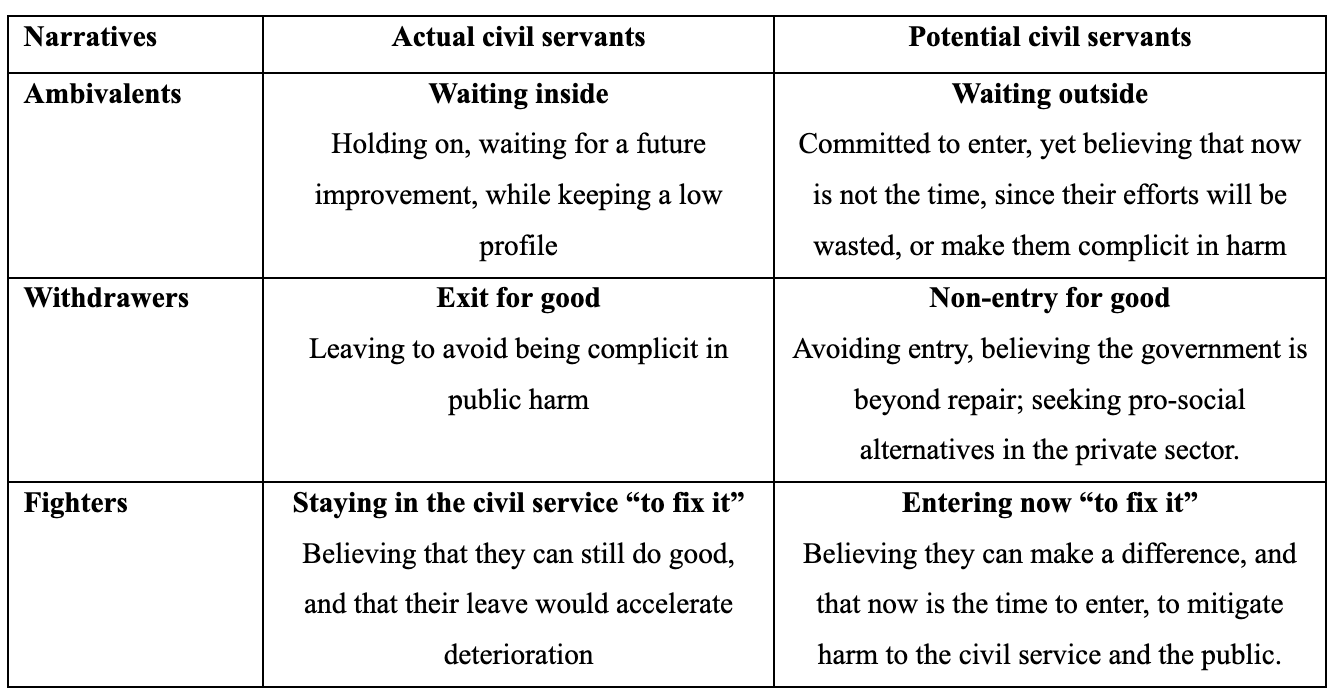
This question matters for the government’s ability to recruit new employees during periods of democratic backsliding or sharp polarization. The table below, drawn from a recent article with my colleagues, develops a conceptual framework that extends Hirschman’s typology by comparing the array of possible responses of existing civil servants with those of potential recruits.
Mirror-image typology of actual and potential employees’ explication of their choice to work or forgo work in government amid democratic and bureaucratic decline
Source: Marciano, Shpaizman, and Gilad, 2026.
Academics seldom acknowledge the possibility that individuals’ choice to seek work in government is influenced by their partisan beliefs and perceptions of the trustworthiness of the party and leaders in power. The established understanding is that some people prefer work in the public sector over the private sector due to their motivation to serve society and their preference for secure, stable employment. This calculus is supposedly shaped by a long-term view of one’s career, which discards the question of which party is heading the government at the time of entry to the civil service.
Partisan support for and trust in governing…

 点赞
点赞 收藏
收藏 点踩
点踩 分享
分享