One Year On from the One Big Beautiful Bill:

Fidelity to the truth has not been a hallmark of the second Trump Administration. Still, the Administration’s claim that the One Big Beautiful Bill Act (OBBBA) does not represent a “cut” to the Medicaid program stands out.
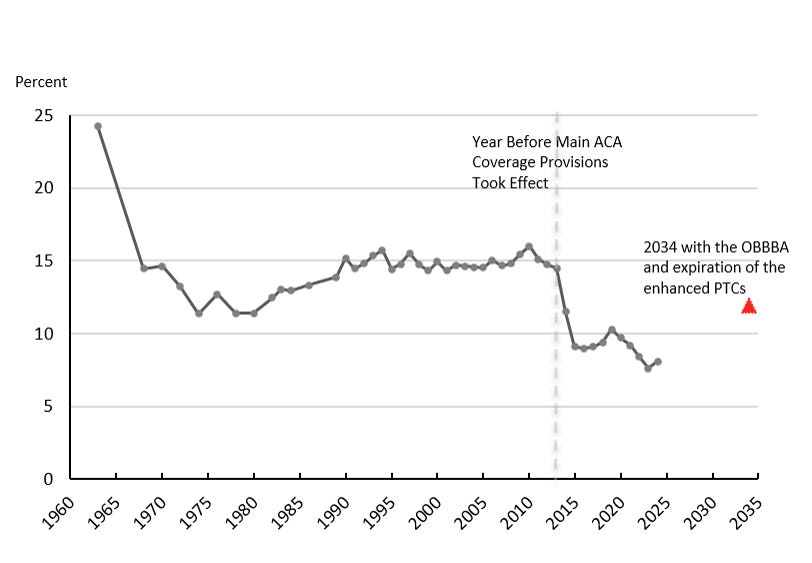
This claim is striking since the non-partisan Congressional Budget Office (CBO) projects that that law, which was enacted one year ago, will reduce federal spending on Medicaid and the Children’s Health Insurance Program (CHIP) alone by over $900 billion over 10 years. Altogether, the OBBBA is projected to result in 10 million more uninsured people in 2034, most of which are due to its cuts to Medicaid and CHIP.
Can We Still Govern? is a reader-supported publication. Consider becoming a free or paid subscriber to get expert independent insights.
These represent the largest cuts in federal support for health insurance coverage in history. According to one early analysis, when combined with some other recent federal policy changes (such as the expiration of the enhanced premium tax credits), the OBBBA is projected to wipe away nearly three-quarters of the health insurance coverage gains made under the 2010 Patient Protection and Affordable Care Act (ACA).
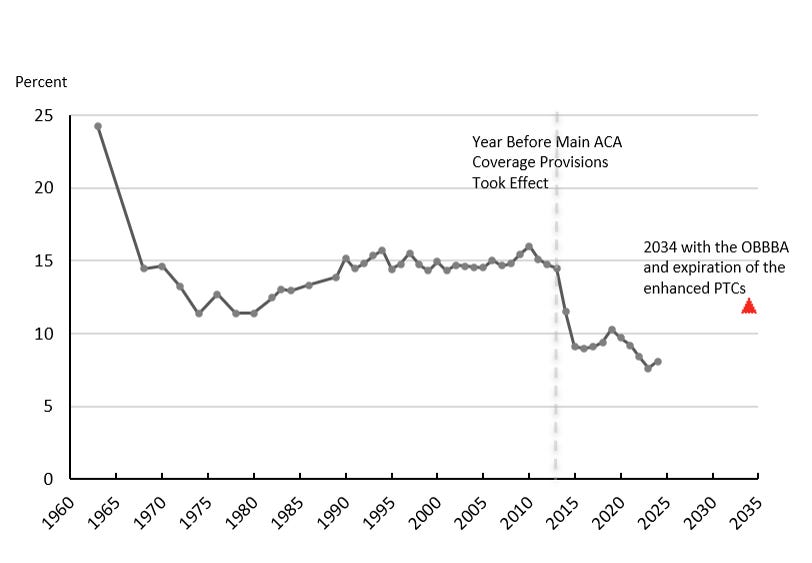
United States Uninsured Rate: Historical and Projected 1
And yet, the Trump Administration, Congressional Republicans, and ideological allies have repeatedly insisted (including in a recent essay published in a prominent medical journal) that the OBBBA does not cut Medicaid. Instead, they have argued, among other things, that the law cracks down on “waste, fraud, and abuse” and “protects Medicaid for the truly vulnerable.”
Let’s evaluate these three claims.
Claim #1: The OBBBA does not cut Medicaid
At the risk of stating the obvious, to describe a law as “cutting” government spending means, colloquially, that it reduces health care spending.
As I outline in a forthcoming article, the OBBBA does just this in three main ways:
imposing a variety of new administrative burdens (including, mos…

 点赞
点赞 收藏
收藏 点踩
点踩 分享
分享