2D Gaussian Splatting for Bézier Spline Line Art Vectorization

2D Gaussian Splatting for Bézier Spline Line Art Vectorization
In this work, we leverage several recent advances in the field to introduce a new state-of-the-art method for line art vectorization.
July 16, 2026
SIGGRAPH (2026)
Authors
Tianhao Chen (DisneyResearch|Studios/ETH Zurich)
Clara Fernandez (DisneyResearch|Studios)
Marteinn Oskarsson (Walt Disney Animation Studios)
Chuck Tappan (Walt Disney Animation Studios)
Olga Sorkine-Hornung (ETH Zurich)
Markus Gross (DisneyResearch|Studios/ETH Zurich)
Christopher Schroers (DisneyResearch|Studios)
Abdelaziz Djelouah (DisneyResearch|Studios)
2D Gaussian Splatting for Bézier Spline Line Art VectorizationDownload Publication PDFDownload Supplemental PDF
Abstract
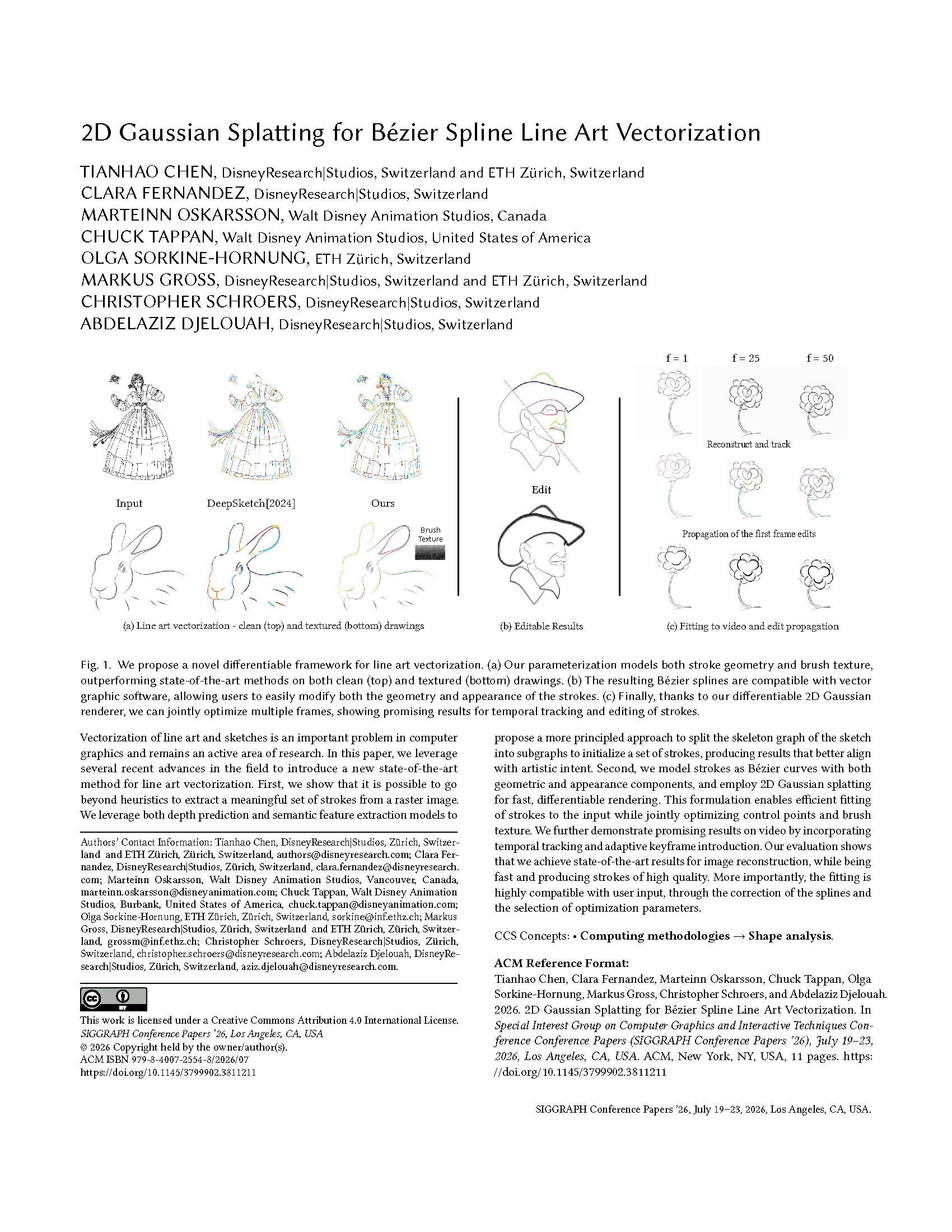
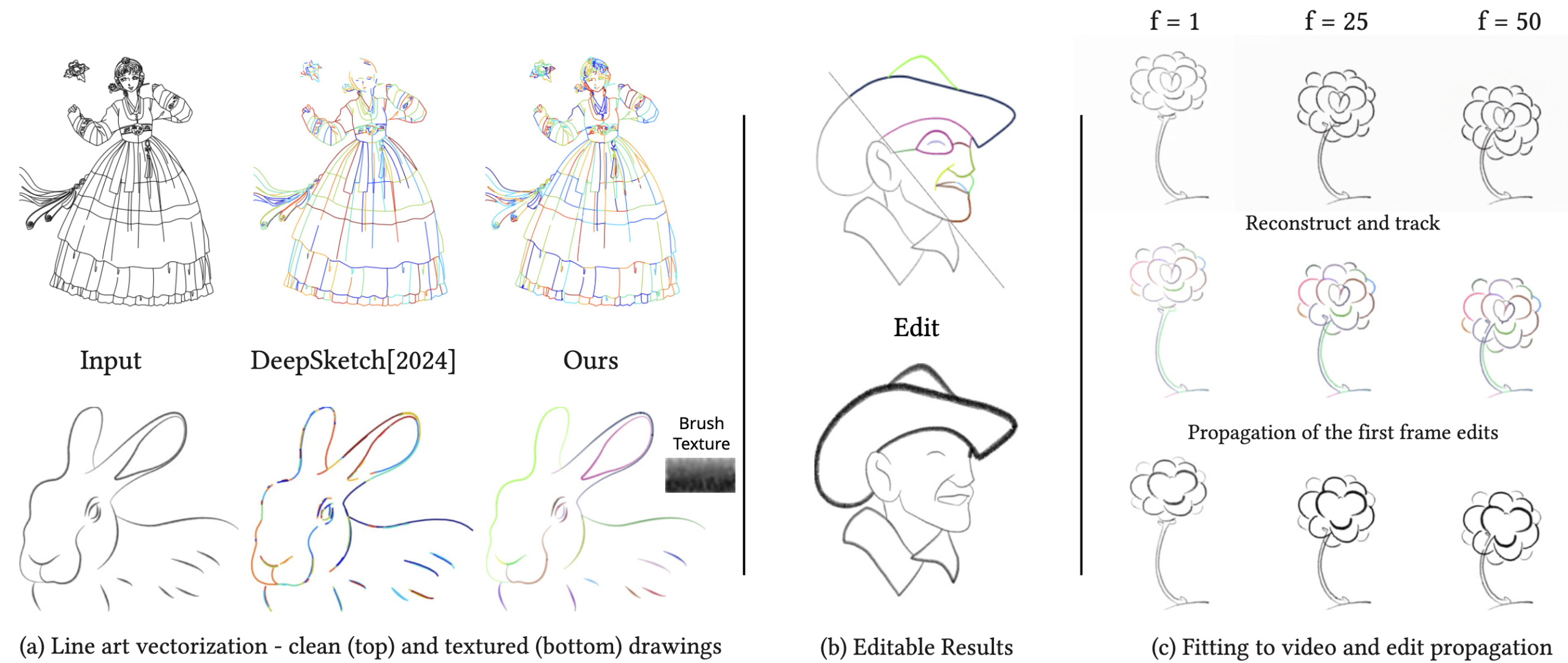
Vectorization of line art and sketches is an important problem in computer graphics and remains an active area of research. In this paper, we leverage several recent advances in the field to introduce a new state-of-the-art method for line art vectorization. First, we show that it is possible to go beyond heuristics to extract a meaningful set of strokes from a raster image. We leverage both depth prediction and semantic feature extraction models to propose a more principled approach to split the skeleton graph of the sketch into subgraphs to initialize a set of strokes, producing results that better align with artistic intent. Second, we model strokes as Bézier curves with both geometric and appearance components, and employ 2D Gaussian splatting for fast, di erentiable rendering. This formulation enables e cient tting of strokes to the input while jointly optimizing control points and brush texture.We further demonstrate promising results on video by incorporating temporal tracking and adaptive keyframe introduction. Our evaluation shows that we achieve state-of-the-art results for image reconstruction, while being fast and producing strokes of high quality. More importantly, the tting is highly compatible with user input, through the correction of the splines and the selection of optimization parameters.
Copyright Notice
The documents contained in these directories are included by the contributing authors as a means to ensure timely dissemination of scholarly and technical work on a non-commercial basis. Copyright and all rights therein are maintained by the authors or by other copyright holders, notwithstanding that they have offered their works here electronically. It is understood that all persons copying this information will adhere to the terms and constraints invoked by each author’s copyright. These works may not be reposted without the explicit permission of the copyright holder.
Research at DisneyHomeResearchPeopleCareersPublicationsOutreachAbout Us
LegalPrivacy PolicyCalifornia Privacy RightsChildren's Online Privacy PolicyTerms of Use
MORENews

 点赞
点赞 收藏
收藏 点踩
点踩 分享
分享