SmoothMotionVectors: Optimizing Your Content for Video Codecs in Free View Video Compression

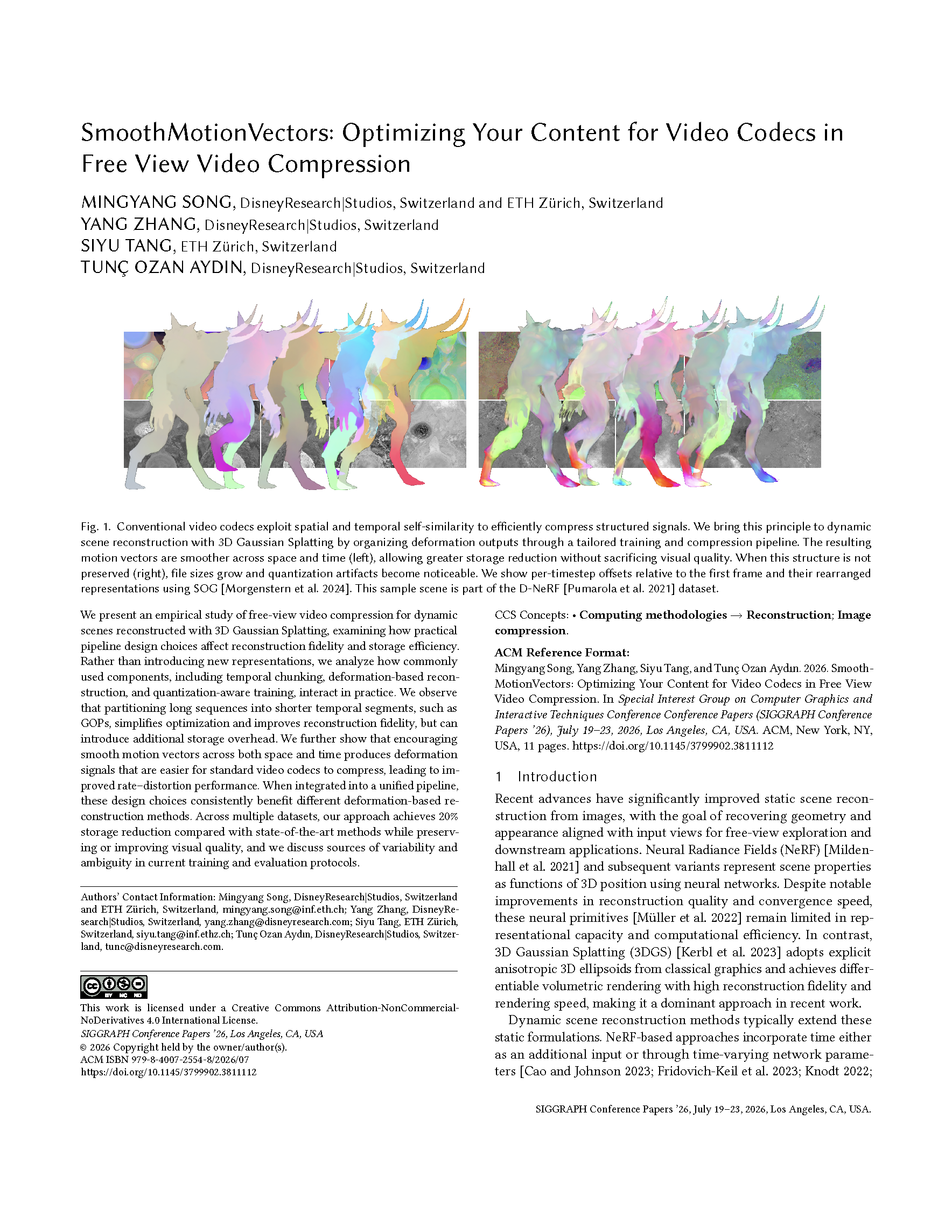
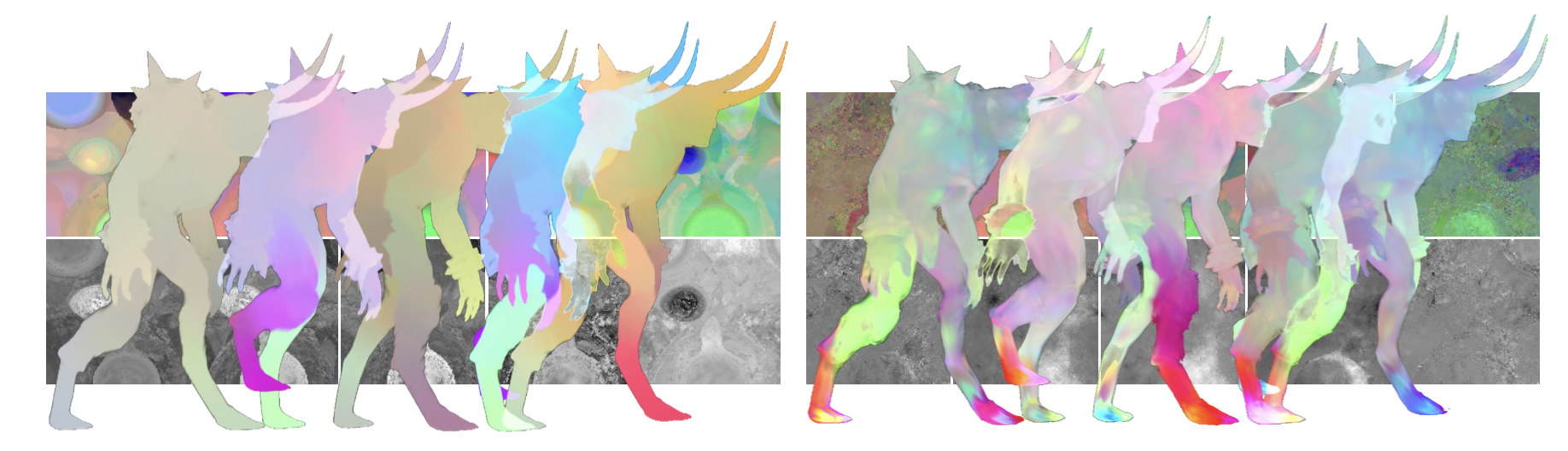
SmoothMotionVectors: Optimizing Your Content for Video Codecs in Free View Video Compression
In this work, we present an empirical study of free-view video compression for dynamic scenes reconstructed with 3D Gaussian Splatting, examining how practical pipeline design choices affect reconstruction fidelity and storage efficiency.
July 16, 2026
SIGGRAPH (2026)
Authors
Mingyang Song (DisneyResearch|Studios/ETH Zurich)
Yang Zhang (DisneyResearch|Studios)
Siyu Tang (ETH Zurich)
Tunç Ozan Aydin (DisneyResearch|Studios)
SmoothMotionVectors: Optimizing Your Content for Video Codecs in Free View Video CompressionDownload Publication PDF
Abstract
We present an empirical study of free-view video compression for dynamic scenes reconstructed with 3D Gaussian Splatting, examining how practical pipeline design choices affect reconstruction fidelity and storage efficiency. Rather than introducing new representations, we analyze how commonly used components, including temporal chunking, deformation-based reconstruction, and quantization-aware training, interact in practice. We observe that partitioning long sequences into shorter temporal segments, such as GOPs, simplifies optimization and improves reconstruction fidelity, but can introduce additional storage overhead. We further show that encouraging smooth motion vectors across both space and time produces deformation signals that are easier for standard video codecs to compress, leading to improved rate distortion performance. When integrated into a unified pipeline, these design choices consistently benefit different deformation-based re- construction methods. Across multiple datasets, our approach achieves 20% storage reduction compared with state-of-the-art methods while preserving or improving visual quality, and we discuss sources of variability and ambiguity in current training and evaluation protocols.
Copyright Notice
The documents contained in these directories are included by the contributing authors as a means to ensure timely dissemination of scholarly and technical work on a non-commercial basis. Copyright and all rights therein are maintained by the authors or by other copyright holders, notwithstanding that they have offered their works here electronically. It is understood that all persons copying this information will adhere to the terms and constraints invoked by each author’s copyright. These works may not be reposted without the explicit permission of the copyright holder.
Research at DisneyHomeResearchPeopleCareersPublicationsOutreachAbout Us
LegalPrivacy PolicyCalifornia Privacy RightsChildren's Online Privacy PolicyTerms of Use
MORENews

 点赞
点赞 收藏
收藏 点踩
点踩 分享
分享