Freedom for Fee — How America Just Monetized the World's Most Important Public Good
I'm Victoria — an Economics student and the founder of Axis Brief. Every week I break down one major shift at the intersection of AI and global power through the lens of economics. Not to inform you. To equip you.
For eighty years the United States Navy has underwritten the free movement of global trade. Warships in contested waters. Escorts through dangerous straits. Military presence in every ocean on earth.
Washington called this freedom of navigation. The world called it reassuring. Economists called it a public good — something valuable, broadly shared, and provided without direct charge to those who benefited from it.
Last week that arrangement changed.
In the middle of an escalating confrontation with Iran over the Strait of Hormuz — through which approximately 20 to 30 percent of global oil transits daily — the United States announced a 20 percent security fee on cargo passing through the strait under American protection.
Three words capture what just happened better than any policy document: Freedom for fee.
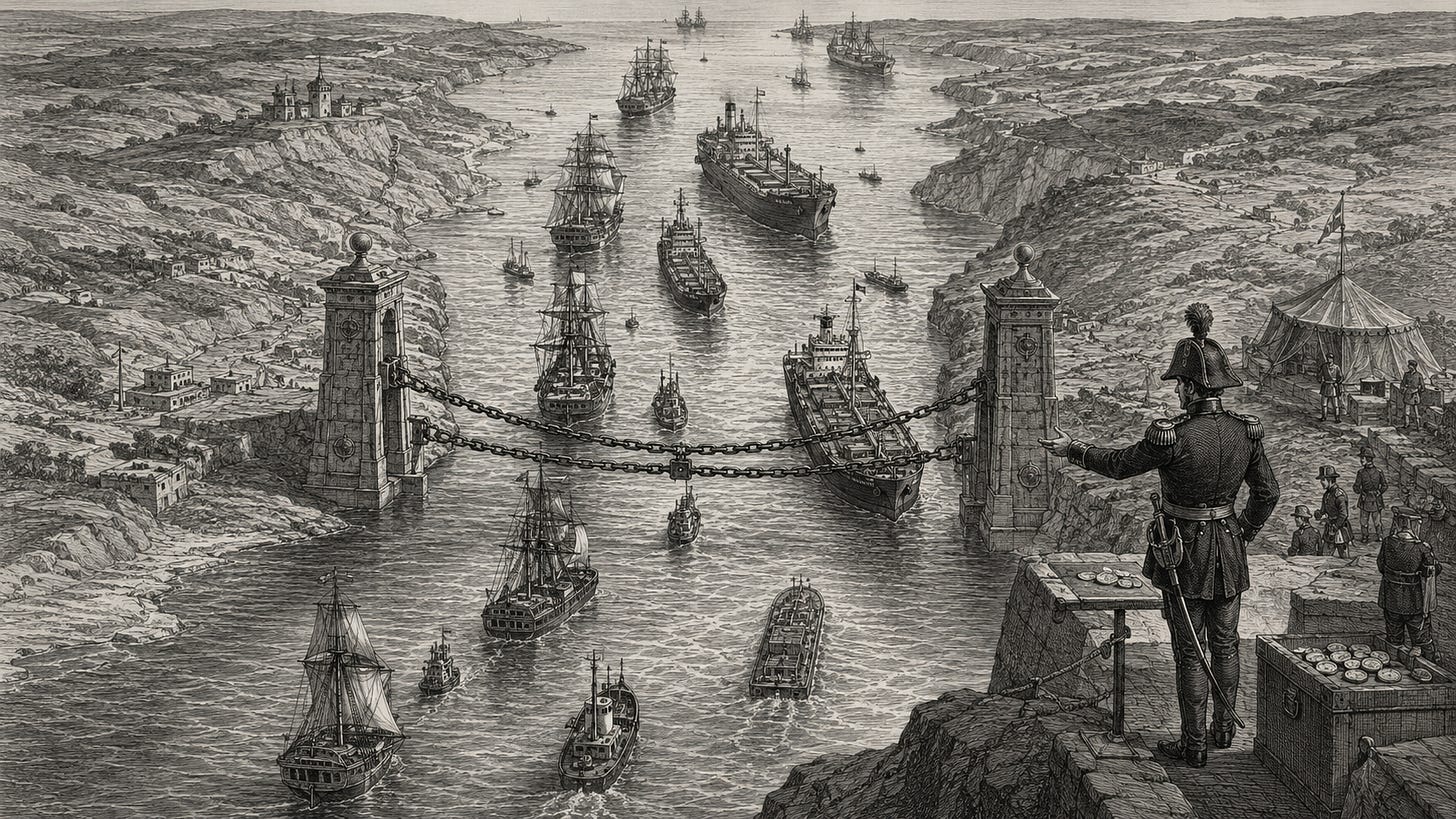
America did not close the strait. America did not abandon its security role. America simply began charging for what it previously provided for free — and in doing so transformed one of the world’s most consequential public goods into a private revenue stream.
The economic implications of that transformation extend far beyond the price of oil this week. They reach into the architecture of the global trading system itself — and into the specific vulnerability of nations that produce the world’s raw materials but have never owned the systems that move, refine, price, or protect them.
What Actually Happened — The Economics Beneath The Headlines
The surface story of the US-Iran confrontation over Hormuz is a military one. Three consecutive nights of American airstrikes on Iranian coastal positions near Bandar Abbas, Bushehr, Kish, and Qeshm. Iranian retaliatory missile and drone strikes on Gulf targets including Bahrain and two tankers in the strait. Brent crude pushing above $84. Hormuz crossings falling sharply within days.
That surface story is real. But it is not the economic story.
The economic story is about what the 20 percent security toll actually represents — and who actually pays it.
Basic economics of fee incidence: the entity that legally pays a fee is rarely the entity that economically bears its cost. Shipping companies will be charged the toll. But shipping supply is inelastic in the short term — fleets are fixed, routes are limited, alternatives are costly. So shipping companies pass the cost forward through higher freight rates. Oil exporters in the Gulf — whose crude is fungible and priced at world markets — absorb almost none of it. The cost travels downstream.
It lands on importers. Europe, South Asia, East Asia — the economies that depend on Hormuz passage for their energy supply bear the majority of the economic burden of an American security fee on an American-protected waterway.
Iran pays indirectly — in lost volume if traffic reroutes, in economic pressure if the disruption persists. But Iran does not pay the toll. The countries that depend most on unimpeded Hormuz passage pay the toll. And the United States — the enforcer — captures the surplus.
Let me address the counterargument directly because it deserves more than dismissal.
Iran is not an innocent party in this crisis. It has attacked tankers, disrupted shipping, and repeatedly threatened to close a waterway the international community depends on. American military presence in the Gulf carries real costs — in personnel, in equipment, in sustained operational expenditure. A security fee, the argument goes, is simply making those costs visible. It is more honest than the diffuse political compliance and dollar dominance that previously underwrote free navigation without anyone calling it a price.
That argument has genuine merit. I am not dismissing it.
But here is what it does not resolve. The economic implications of the Hormuz toll are consequential regardless of who is morally right — because once the precedent exists that a major power can monetize a global maritime commons under the justification of security provision, the justification becomes separable from the action. The first toll may be defensible. The model it establishes does not require defensible justifications to be replicated. What matters economically is not whether America was right to charge in 2026. It is whether the next actor to control a critical strait will need to meet the same standard of justification — or simply point to the precedent and proceed.
History suggests the latter.
This is textbook chokepoint economics. Whoever controls the bottleneck captures value from everyone who has no alternative. The controller does not need to produce anything. They need only to be the entity without whom passage is impossible — and then charge accordingly.
America just applied that logic to the most important maritime chokepoint on earth.
The US has long framed its role in Hormuz around freedom of navigation. Now it's openly moving toward a toll-and-protect model — effectively monetizing security in one of the world's most important trade routes.
The Analogy That Explains What Most Coverage Misses
Consider this illustration — not a factual account but a way of seeing the structural logic clearly.
Imagine a student who wants to study economics abroad. Entering one country costs money, requires extensive documentation, and demands significant personal investment — the barriers are visible and explicit. But another country offers something different: free entry, a full scholarship, a welcome package. The student chooses the second option immediately.
What the student did not see was the extraction embedded in the generosity. The scholarship required the student to contribute research solutions to the host country’s economic problems as part of the coursework. The free entry was not free. It was payment deferred and disguised — intellectual output extracted under the language of opportunity.
This is what eighty years of American freedom of navigation actually was.
The United States provided free passage — genuinely, and at real cost to American taxpayers and military personnel. But that provision was never purely altruistic. It was underwritten by political compliance from allies, by dollar dominance in global trade settlement, by base access agreements across the Middle East and Asia, by the soft power that accrues to the nation that provides what everyone else depends on.
Freedom of navigation was not free. It was paid for in political and economic concessions that the beneficiaries often did not fully account for — because the price was distributed across decades and disguised as partnership.
The 20 percent toll makes the price explicit. In that narrow sense it is more honest than what preceded it. But its honesty does not make it less consequential for those who pay.
The Consensus View — And What It Refuses To See
The dominant framing of the Hormuz confrontation in government statements, financial markets, and major media runs approximately as follows: this is a serious but contained escalation. Both sides are engaging in calibrated tit-for-tat exchanges. Neither wants full-scale war. Markets should expect elevated oil prices and higher insurance premiums as a persistent background condition — unpleasant but manageable.
That framing is not wrong. It is incomplete in ways that matter economically.
What the consensus refuses to see:
First — escalation is not linear or controllable. The assumption that both sides can calibrate their responses with sufficient precision to avoid miscalculation is historically unsupported. Chokepoint crises cascade faster than models predict. One sunken tanker with mass casualties. One successful Iranian strike on a US asset. One proxy overreach by Houthi forces in the Red Sea. Any of these breaks the managed escalation narrative ins…

 点赞
点赞 收藏
收藏 点踩
点踩 分享
分享