AI companies are throwing museums a lifeline. What do they want in return?

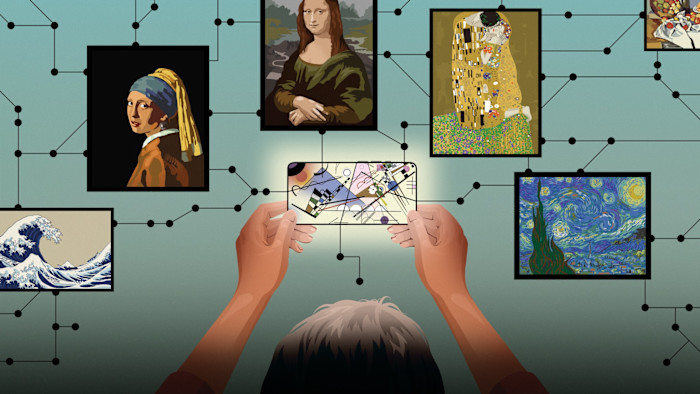
Visitors to Leighton House museum in west London recently may have been surprised to encounter QR codes encouraging them to call up the long-deceased master of the house. Those who obliged would have found themselves in conversation with a velvety voiced AI model of Frederic, Lord Leighton, talking about his trips to the Middle East, where he collected tiles for the museum’s magnificent Arab Hall.
Facing falling visitor numbers, shrinking funds and competition for attention in a crowded marketplace, museums are turning to AI to forge a new relationship with audiences, as well as to develop more efficient management systems and funding opportunities.
In 2026, museums are at an inflection point. Public funding has been slashed, ethical controversies have had a chilling effect on corporate sponsorship, and a generation of dependable private donors is ageing out. National museums in England reported a 10 per cent drop in visitors aged under 16 in 2024-25, reflecting a broader global trend. Attendance at the world’s 100 most visited museums was 13 per cent lower than before the pandemic, dragging down ticketing and trading income.
While the objects that museums steward remain unchanged, the way people engage with them is evolving. Visitor-facing AI such as that at Leighton House has been on the rise since large language models (LLMs) exploded on to the market, based on the idea that a new generation might be more comfortable talking to a chatbot than reading a wall text. New York’s Metropolitan Museum of Art created a chatbot mimicking socialite early-20th-century socialite Natalie Potter for its 2024 Costume Institute exhibition. At the Dalí Museum in St Petersburg, Florida, visitors can call up a reanimation of the surrealist painter on a lobster phone. More recently, US President Donald Trump spoke with an AI version of Theodore Roosevelt on a visit to the Presidential Library in North Dakota.
“We are a transitional generation,” says András Szántó, author and strategic adviser to institutions including the Met and an AI-powered museum companion called Artlas. Conversational AI is “the language of our time, or our future”, he says.
But far from everyone in the field is convinced. Museum professionals worry that these tools will spout inaccuracies and bias or flatten interpretation to gimmickry, undermining museums as a trusted source of knowledge. “LLMs are notoriously unreliable and cannot be trusted to always tell the truth, which is highly problematic in a museum context,” writes Anders Sundnes Løvlie, an associate professor at the University of Copenhagen, in a research paper on museum chatbots. This is especially risky given that “LLMs tend to speak in a manner which human users find very convincing”.
“Cultural homogenisation is upon us with these trends, while turning a visitor, a reader, a listener, into the filter of AI art slop,” says Nataliya Kosmyna, a research scientist at the Massachusetts Institute of Technology Media Lab’s Fluid Interfaces group. “If no actual human wrote it, no human edited it, no human signed off on it, then what right does it have to tell me, a human, anything about my and our collective human history, art or culture?”
Marion Carré, co-founder and chief executive of AI company Ask Mona, is familiar with these objections. Over the past decade, Ask Mona has developed conversational experiences for visitors at institutions from the Louvre to the Musée national des beaux-arts du Québec to “talk” to artworks, specimens, historical figures or virtual guides. “I really wanted to make a way for people to feel more welcome and comfortable inside the museum,” Carré says. In Québec, Ask Mona increased the average time spent in front of an artwork from five seconds to five minutes, she adds.
Cultural homogenisation is upon us with these trends, while turning a visitor, a reader, a listener, into the filter of AI art slopNataliya Kosmyna, MIT Media Lab
Cultural homogenisation is upon us with these trends, while turning a visitor, a reader, a listener, into the filter of AI art slop
Carré has had to work hard to persuade curators that bespoke models are qualitatively different from popular LLMs trained on vast tracts of unvetted internet text. “It all depends on what you put inside it,” she says. “If you put garbage in, it’ll be garbage out.” Institutions can curate datasets their models draw from and program how they respond. Misunderstandings can still occur, Carré says, but the same might be said for humans, too.
AI models are particularly touted for their potential for personalisation — they can theoretically adapt to the needs of a child or an adult, converse in their spoken language, and match their education level. As museums increasingly move away from presenting a singular, dominant narrative, dynamic interfaces also create room for more polyphonic readings.
If AI can make the museum experience smoother, Carré says she encourages her museum clients to think where they want to retain friction. This might involve the model asking questions to prompt critical thinking, rather than simply feeding people answers. Over-reliance on generative AI has been shown to weaken memory pathways and problem-solving skills, and to lead to homogenised thinking. And there are other areas of expertise, such as curation and research, where delegating to generative AI may not be appropriate. “It’s important to think of where we should preserve creativity,” Carré says.
In a moment of downsizing, when museums lack the expertise or funding to build their own models, AI companies seem to offer a lifeline, says Doug Gurr, who became director of London’s Natural History Museum in 2020 after nearly a decade at Amazon. “But any museum needs to be an ‘intelligent customer’ and at least consider the alternative of building out their own in-house AI capabilities.” (His own institution has had a dedicated AI team for more than five years.)
This is especially true when museums are sitting on a trove of specialist knowledge — data — that is a font of untapped revenue. The Natural History Museum, alongside other institutions, including London’s Imperial War Museum and V&A, is part of a pilot marketplace backed by the UK government, where institutions are monetising their high-quality data by licensing it to AI developers. A critical lesson, Gurr says, is that public institutions should stop giving database access to commercial users for free.
“It’s early days, but we’ve already learnt that curating a critical mass of unique, distinctive datasets has piqued the interest of even some of the largest global technology companies,” Gurr says. Last month, his museum licensed its biodiversity health data to asset management group BlackRock, which is using it to improve the model for its sustainable investing intelligence platform.
Recommended
With AI already drawing scrutiny for its environmental impact, the move may raise eyebrows. Gurr contends that ethical considerations are “hard-wired into all our decision-making processes”, adding that the data-use cases are tightly controlled and that the partnership furthers the museum’s mission “by helping to ensure that capital market investment decisions factor in the impact of nature”.
The future of museums “is going to be an exercise in leadership . . . and values or principles that determine how you navigate these trade-offs”, says museum strategist Szántó. “The doomsday version of it is that everything gets watered down. The hopeful narrative is that knowledge brands that know how to navigate this landscape actually put out a better product that more people rely on.”
Find out about our latest stories first — follow FT Weekend onInstagram, Bluesky andX, and sign up to receive the FT Weekend newsletter every Saturday morning

 点赞
点赞 收藏
收藏 点踩
点踩 分享
分享