Masa Son’s greatest gamble

One scoop to start: HSBC is halting lending to riskier private credit clients, after high-profile bankruptcies cast doubt on underwriting standards in the sector and pushed banks to cut their exposure.
Welcome to Due Diligence, your briefing on dealmaking, private equity and corporate finance. This article is an on-site version of the newsletter. Premium subscribers can sign up here to get the newsletter delivered every Tuesday to Friday. Standard subscribers can upgrade to Premium here, or explore all FT newsletters. Get in touch with us anytime: [email protected]
In today’s newsletter:
• Masayoshi Son’s AI ambitions • Corporate Britain for sale • Solstice strikes a $14.5bn deal
Masayoshi Son’s AI ambitions
Corporate Britain for sale
Solstice strikes a $14.5bn deal
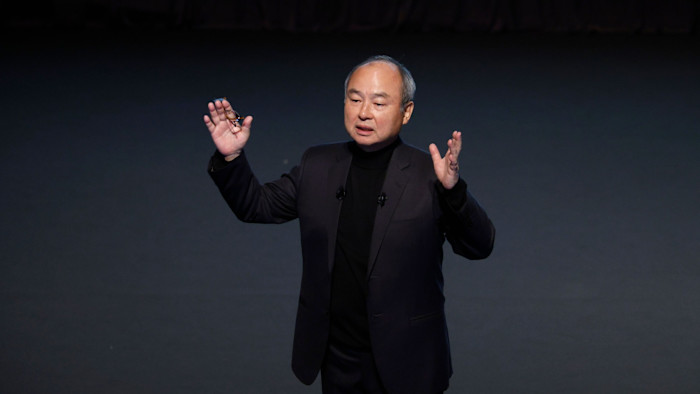
How Masa Son built the bank of AI
Back in 2018, Blackstone co-founder Stephen Schwarzman gave the best diagnosis of Masayoshi Son’s tech empire, SoftBank.
On an earnings call that winter, Schwarzman toasted Son’s ability to invest ever-greater sums of money into tech companies that don’t generate cash flow. “That’s a highly specialised set of characteristics,” Schwarzman said.
The hyper-competitive Schwarzman also presciently noted that companies within Son’s sprawling investment vehicle would have to keep raising more and more equity to finance their growth.
“He’s been very clever, and he’s made some very good choices historically, and had good returns,” Schwarzman said, adding, “he’s an outlier in terms of sort of his, not to beat the phrase, vision”.
When it came to AI you had two choices in that era: go all in like Son or play it conservatively like Blackstone, which became the industry’s pre-eminent infrastructure investor.
Since Schwarzman’s comments, SoftBank has faced numerous booms and busts. It’s now riding high thanks to a wildly lucrative bet on the UK chip designer Arm, which it has used to finance even more ambitious bets on AI, the FT reports in a Big Read.
Son has played his cards well with some companies such as Alibaba and Yahoo, but also had significant flops, most notably with WeWork. SoftBank was also punctuated by controversy, including large bets on Greensill and Wirecard, two companies engulfed in scandal.
Perhaps his biggest wager of all is on OpenAI. SoftBank has committed to invest $64.6bn into Sam Altman’s start-up, for an eventual stake of roughly 13 per cent, helping put Son at the centre of the AI boom. SoftBank’s stock has surged in recent months as investors try to get exposure to OpenAI’s forthcoming IPO.
Despite the recent share surge, the market is sceptical of Son’s strategy. SoftBank trades at a roughly 50 per cent discount to its net asset value, far from the premium enjoyed by Berkshire Hathaway, another holding company built around a totemic investor.
The clearest example of the discount is Arm, of which SoftBank owns roughly 90 per cent, a stake now worth more than the Japanese group’s own market cap.
Son, who owns a third of the company he started 45 years ago, doesn’t feel obliged to explain himself and often keeps his plans secret. Some analysts and investors say it would behove him and the value of his company to take the time to sell investors on his vision.
Another source of scepticism for investors is SoftBank’s complex financing, which involves borrowing against his successful companies, including Arm, to finance his AI bets.
The group’s current leverage — as seen through its own stated 17 per cent loan-to-value ratio at the end of March — has been helped by rising asset prices but that could quickly change if markets fall.
SoftBank has become a big player in Japan’s AI strategy and is growing in influence on the global stage. The tech conglomerate is developing a $33bn gas-fired power plant in Ohio that will power one of its data centres and has pledged an up-to-€75bn data centre rollout in France.
Multiple bankers and government officials describe the company as approaching “too big to fail” status. Some worry about the circular nature of its role in AI, where SoftBank is both investor and customer of Arm and OpenAI.
Since Schwarzman’s comments eight years ago, public markets haven’t picked a winner when it comes to AI; Blackstone and SoftBank’s shares have risen by similar amounts.
The UK’s summer of deal mania
This summer in London has featured all the classics: Wimbledon, an influx of tourists and the sale of marquee UK assets to overseas bidders.
The deal market in the City has kept pace with the blistering temperature, as total UK M&A value has more than doubled from last year to reach $324bn through late June. That was driven by foreign buyers snapping up UK companies at a record pace.
The acquisition of UK assets by overseas buyers more than tripled to reach nearly $200bn, data from the London Stock Exchange Group showed.
London’s deal advisers across investment banks, law firms and communications consultancies are set to benefit from the strong increase in activity.
But there is a tinge of uneasiness as an increasing number of clients are sold off without a pipeline of new listings to replenish the hopper.
The frenzied pace has picked up in recent days. On Sunday, the US credit firm Castlelake reached an outline agreement on a £5.5bn takeover of the budget airline easyJet, while on Monday the US media group Comcast agreed a £1.6bn deal for its Sky unit to acquire ITV’s television business.
Novartis also on Monday agreed a $1.5bn deal to acquire the UK cancer treatment group Myricx Bio.
And there are plenty of other such deals out there over the past few weeks, whether it be the planned acquisition of FTSE 100 energy group DCC by KKR and Energy Capital Partners for £5.7bn, or US property group Prologis’s proposed £12.6bn takeover of UK rival Segro.
Even Lockheed Martin’s $3.5bn deal on Monday to acquire naval tech group Ultra Maritime from Advent had UK roots, given that Advent acquired the British parent groups Cobham and Ultra in recent years.
Investors and advisers all cite various reasons for the strong rise in inbound takeovers, including undervalued shares and pressure to consolidate at a time when the rise of AI giants has spurred changes across sectors.
Either way, dealmakers are hoping that after the summer shopping spree the local market will eventually be restocked via IPOs.
A summer Solstice of deals
Only eight months ago, Solstice Advanced Materials chief executive David Sewell was ringing the Nasdaq opening bell to hail the speciality chemicals group’s first trading day after spinning off from industrial conglomerate Honeywell.
Solstice on Monday announced loud and clear to the market that the fledgling company had aspirations as an empire builder, striking a $14.5bn deal to combine with advanced materials group Element Solutions which will almost double its revenues.
DD’s Oliver Barnes scooped the deal early on Monday.
For industry watchers familiar with Sewell’s CV, this deal should be no surprise. In his last job, he stitched together Smurfit Kappa with Westrock to create Smurfit Westrock, a global paper and packaging giant.
The largely stock-based deal takes advantage of Solstice’s gangbusters share price performance since it broke away from Honeywell last October, which before Monday’s announcement was up 75 per cent since the spin-off. The deal sent Solstice’s stock tumbling 15 per cent, however.
Solstice had expressed interest in an acquisition towards the start of the year but returned to the negotiating table with full gusto in recent months, according to people familiar with the matter. The structure of the deal, including a chunky premium and offering three board seats to Element, helped smooth its path.
Solstice was the first part in Honeywell’s three-way, mega break-up. The latest chapter was written late last month as the remainder of the industrials bellwether split in two to create Honeywell Technologies and Honeywell Aerospace — one focused on automation and the other aerospace and defence.
Will these other Honeywell offshoots turn to dealmaking as quickly as Solstice? Almost certainly. Expect plenty of bolt-on acquisitions as both new management teams have made clear. But also it is entirely possible they end up as hunters or hunted in their own grand piece of dealmaking.
Job moves
• Ocado’s founder and chief executive Tim Steiner will remain in post until the 2028 financial year and then step into an advisory role, after a boardroom plot to remove him resulted in investors calling for the chair to step down instead. • Vale chair Daniel Stieler is stepping down following a proposal by pension fund Previ to replace him, Bloomberg reports. • Paul Hastings has hired Peter Williams as a private credit partner in New York. He joins from Cahill Gordon & Reindel.
Ocado’s founder and chief executive Tim Steiner will remain in post until the 2028 financial year and then step into an advisory role, after a boardroom plot to remove him resulted in investors calling for the chair to step down instead.
Vale chair Daniel Stieler is stepping down following a proposal by pension fund Previ to replace him, Bloomberg reports.
Paul Hastings has hired Peter Williams as a private credit partner in New York. He joins from Cahill Gordon & Reindel.
Smart reads
Mind-bending Four former university classmates in Italy became billionaires last week when their software roll-up Bending Spoons went public, the FT writes. Now the highly leveraged company, with debt of about $4.4bn, is trying to keep growing.
AI battles Start-ups OpenAI and Anthropic have been riding high on AI exuberance, John Thornhill writes for the FT. But as they eye the public markets they face punishing costs and growing competition.
Tax loss One of Europe’s largest hedge funds warned “the UK is no longer a serious contender” as a place to do business after a tax ruling last week. But BlueCrest had pursued a particularly aggressive structure that attracted the attention of tax authorities, the FT writes.
News round-up
Canada chooses Germany’s TKMS for landmark submarine contract (FT)
Hedge fund run by ex-OpenAI researcher bets on SK Hynix’s US IPO (FT)
Judge rules insurers do not need to pay out over Nord Stream pipeline blasts (FT)
Defence groups strike $8bn of maritime tech deals (FT)
Zuber Issa strikes deal to buy former Prax Group petrol stations (FT)
CVC sells marina business for more than €1bn as yacht market booms (FT)
Due Diligence is written by Arash Massoudi, Ivan Levingston, Ortenca Aliaj, Alexandra Heal, Robert Smith and Aaron Kirchfeld in London, James Fontanella-Khan, Sujeet Indap, Eric Platt, Antoine Gara, Amelia Pollard, Kaye Wiggins, Oliver Barnes, Tabby Kinder and Julia Rock in New York, George Hammond in San Francisco and Arjun Neil Alim in Hong Kong. Please send feedback to [email protected]
Recommended newsletters for you
The AI Shift — John Burn-Murdoch and Sarah O’Connor dive into how AI is transforming the world of work. Sign up here
Unhedged — Robert Armstrong dissects the most important market trends and discusses how Wall Street’s best minds respond to them. Sign up here

 点赞
点赞 收藏
收藏 点踩
点踩 分享
分享